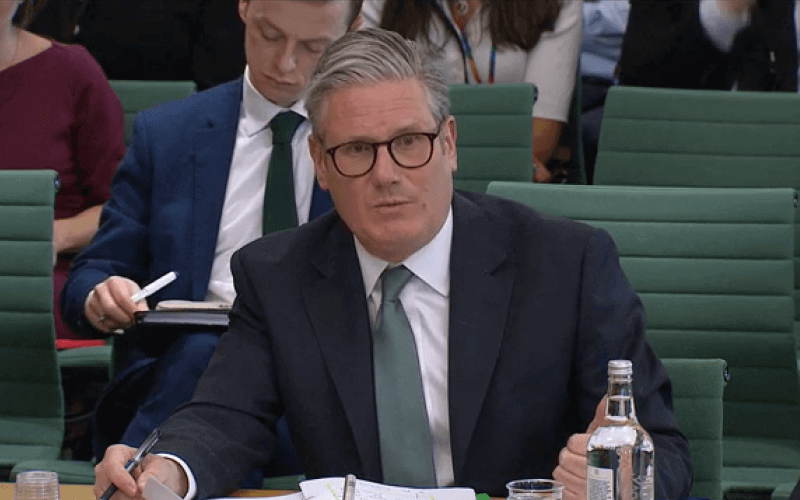
The prime minister has been forced to face the fears of disabled people who are unable to work and have been left feeling “full of panic” and “physically sick” at the thought of benefit cuts that could leave future claimants £3,000 a year worse off.
Sir Keir Starmer (pictured) was appearing in front of the Commons liaison committee* on Tuesday when Labour’s Sarah Owen told him about some of the emails she had received from disabled people since the Pathways to Work green paper was published last month.
She highlighted that potentially 730,000 future members of the universal credit limited capability for work-related activity group could be £3,000 a year worse off under the plans.
She told the prime minister of three disabled people who had contacted her.
One said: “I am beyond stressed with anticipation of losing money. I have £700 to live on this month.”
Another told Owen: “The proposed cuts to disability benefits have left me feeling full of panic about the future and extremely let down.”
And a third disabled person said: “I feel so sick, physically sick. The whole process is horrid. Please represent me.”
Owen, who chairs the Commons women and equalities committee, asked Sir Keir what he would say to these three disabled people.
But although the prime minister said the question of “how people feel and values is really important”, he then defended the policy without expressing any empathy for the fears the three disabled people had expressed.
He said the “guiding principles” of the reforms were “really important, which is those people that do need support and protection should get support and protection, [and] those that want to bridge into work should be supported by the government to bridge into work” and that “those that can work should work”.
He added later that the government would stop reassessing those disabled people who will never be able to work “because certainly that’s something I’ve picked up as a constant cause of anxiety”.
Although the Pathways to Work green paper did announce a new “additional premium” for “those with the most severe, life-long health conditions, who have no prospect of improvement and will never be able to work”, there is no suggestion yet of how many will qualify for that group and how much the premium will be.
Owen also suggested that it would have made more sense for the government to address issues such as “medical misogyny” and the crisis in women’s health – including conditions such as heavy periods, painful periods, endometriosis, fibroids and ovarian cysts – which costs the UK economy nearly £11 billion every year, before cutting disability benefits.
She said it currently takes an average of eight to 10 years for an endometriosis diagnosis, which is “eight to 10 years that a woman is potentially out of the workplace”.
She said: “If we are looking at effective ways to get people into work, perhaps there are other areas that we should be exploring as well.”
Sir Keir said he agreed that the delays were “completely unacceptable” and that this was one of the areas “the health service needs to be better set up to deal with”.
Labour’s Debbie Abrahams, chair of the work and pensions committee, asked the prime minister how the government would avoid causing similar increases in mental ill-health and disability poverty to those caused by the 2017 reforms introduced by the Conservative government.
Those cuts saw new claimants of employment and support allowance placed in the work-related activity group having their support cut by nearly £30 a week.
In his response, Sir Keir did not mention the risks to mental health or increased disability poverty, but instead he told Abrahams that he believed the government’s measures “could make a huge difference”, including the right to try work without a disabled person needing a reassessment if that was not successful and they needed to restart their universal credit claim.
Abrahams also asked the prime minister if he would promise not to implement measures set to be introduced in the government’s planned legislation until there had been a proper assessment of their impact on those affected, because “otherwise, potentially, we will have policy that won’t work and could actually do harm”.
The bill, set to be introduced to parliament in the coming weeks, will include measures that will cut spending on personal independence payment (PIP) by £4.5 billion a year by 2029-30, and reduce the health element of universal credit.
The rate of the health element will be cut from £97 per week in 2024-25 to £50 per week in 2026-27 for new claimants, while it will be frozen for existing claimants until 2029-30.
But Sir Keir told her: “We need an evidence base, but we also need to get on with the work that we need to get on to.
“So I’m not going to make commitments in relation to timetabling, but I absolutely take the point you put to me.”
*The liaison committee is made up of the chairs of Commons committees and usually questions the prime minister three times a year
Correction: An early edition of this story wrongly stated in the first paragraph that the cuts could leave future claimants £3,000 a month worse off. It should of course have been £3,000 a year, as it stated accurately in the third paragraph. This has now been corrected.
A note from the editor:
Please consider making a voluntary financial contribution to support the work of DNS and allow it to continue producing independent, carefully-researched news stories that focus on the lives and rights of disabled people and their user-led organisations.
Please do not contribute if you cannot afford to do so, and please note that DNS is not a charity. It is run and owned by disabled journalist John Pring and has been from its launch in April 2009.
Thank you for anything you can do to support the work of DNS…
 Scores of DWP failings linked to deaths were kept from MPs voting on benefit cuts, secret reports reveal
 Changes to energy bill discount scheme will discriminate against many disabled people, campaigners warn
 Government’s advisers warn DWP minister he may need to ‘shift entrenched concerns’ over work reforms