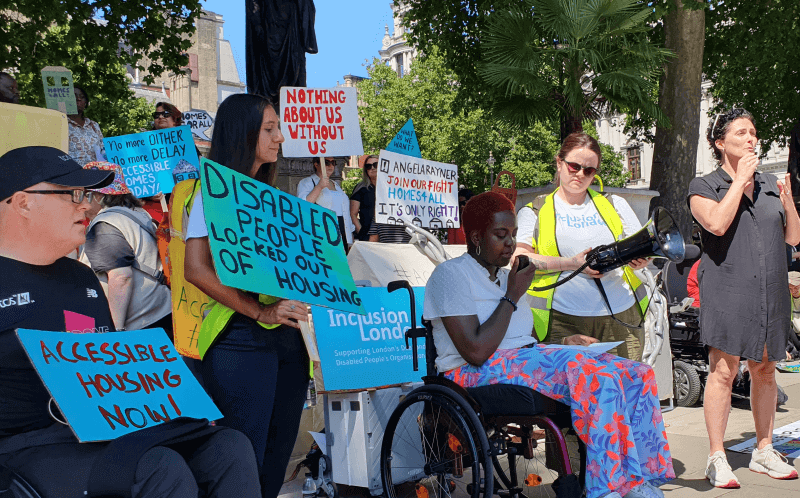
There will be “disastrous consequences” for disabled Londoners if the mayor and local authorities fail to take urgent action to increase the number of accessible homes in the capital, according to new user-led research.
The Barriers at Home report, the product of two years of research by the disabled people’s organisation Inclusion London, says some local authorities have admitted to “very limited understanding” of the accessibility standards they are supposed to monitor when new homes are being built.
And of 33 local councils across the capital, 24 of them have made no plans for the building of new affordable, accessible homes.
The report – launched at City Hall last night (Wednesday) at an event hosted by Green London Assembly member Zoe Garbett – says the mayor’s Greater London Authority (GLA), London councils and central government must “massively increase” the supply of accessible social housing.
It says the shortage of accessible and wheelchair accessible homes is “particularly acute” in the social rented sector.
And it warns that, despite the acute shortage of wheelchair-accessible homes in the capital, London’s mayor, Sadiq Khan, is failing to capture the data necessary to monitor how many accessible homes are being built.
Unless urgent action is taken, the report says, disabled people’s quality of life “will continue to drastically diminish, and health inequalities will rise”.
Among its conclusions, the report says most local planning authorities in London are not effectively assessing the housing needs of disabled residents, while most councils have limited knowledge of the accessibility of their existing housing stock.
Only two London councils were able to provide Inclusion London with a complete breakdown of how many accessible new homes they were approving across social housing and for private sale.
The data collection failures of both GLA and local authorities mean it is impossible to assess how many affordable homes are being built to accessibility standards and how many accessible homes are built for social rent or for sale on the private market, the report says.
Even though the mayor’s London Plan requires 90 per cent of new homes to be accessible and adaptable (meeting the M4(2) standard), and another 10 per cent to be suitable for wheelchair-users (meeting the stricter M4(3) standard, either because they are immediately accessible, or because they can be adapted for use by a wheelchair-user), he has failed to enforce those targets.
Data shows that the proportion of homes approved that met the M4(2) standard dropped from 58 per cent in 2018-19 to just 1.58 per cent in 2022-23, while the proportion of approvals meeting M4(3) dropped from 8.41 per cent to 3.75 per cent over the same four years.
The report makes 54 recommendations for the mayor, the capital’s 33 local authorities, and central government.
Tracey Lazard, Inclusion London’s chief executive, says in the report: “Most of the housing experiences we captured in this report reveal a stark and dire reality: too many people are living in extremely unsuitable conditions which severely impact their physical and mental health and prevent them from living independently.”
Abbi, one of the disabled Londoners who spoke to Inclusion London for its report, told the launch event last night: “When I live in an accessible home, the impact on my mental and physical health is tangible.
“I am less likely to take time off work, I have lower health and care needs, I am better able to take part in social activities and access the community.
“I am more likely to reach out to my own network for emotional and practical support, rather than being dependent on institutions.”
Adam Gabsi, chair of Inclusion London and a wheelchair-user and social housing tenant, told the event: “Social housing isn’t just affordable, it’s stable, and this stability is vital for disabled people.
“Knowing that I have a home where all of my needs are met and where I’m not at risk of sudden rent increases or eviction gives me peace of mind to focus on living my life.
“For disabled people who already feel uncertainty in other areas, secure housing provides a foundation for safety and dignity.”
He added: “We need more accessible housing, and we need more secure forms of housing within the social rented sector.
“Accessible housing should be affordable, and affordable housing should be accessible.”
Garbett had said earlier: “What this report highlights so clearly is that disabled Londoners feel [the housing crisis] even more acutely and have to contend with so many additional barriers to living comfortably.”
She said the stories outlined in the report were “absolutely heart-breaking and enraging and make it impossible to come away from reading this report without recognising the injustice faced by disabled Londoners and the urgent need for reform”.
She said she hoped it was “enough to shift the narrative, get accessible housing onto the agenda and put us on track to properly reckon with the housing crisis”.
A spokesperson for the mayor said in a statement: “The mayor is committed to meeting London’s diverse housing needs and has allocated more than £100 million in funding to deliver well-designed, supported housing to enable disabled Londoners to live independently and access appropriate care.
“The mayor also requires a minimum percentage of accessible and adaptable units in all new housing developments funded by his Affordable Homes Programme, helping to build a fairer and better London for everyone.”
The mayor’s office said it was the responsibility of local planning authorities to assess whether planning applications comply with the M4(2) and M4(3) requirements of the London Plan.
Before 2020, the high volumes of planning applications made it impossible for GLA to access live data and monitor compliance, the mayor’s office said.
But it said GLA had now introduced a digital approach to monitoring compliance, which has shown that the conditions required by the London Plan were not met in the past.
And it said GLA was continuing to work with local authorities to improve the quality of this data and improve compliance with the London Plan.
Of nearly 100 disabled Londoners who responded to an online survey for the Inclusion London report, a third of those with mobility impairments said they did not have level access in their homes, while a third had been forced to cut back on essentials such as food so they could afford to pay their housing costs, while a similar number had had to cut back on gas or electricity.
One in four respondents said they lacked the accessibility features they needed to use the toilet, while one in six lacked the adaptations they needed to use their bath or shower.
Cassie, one of the disabled people Inclusion London spoke to for its report, told its researchers: “When I can’t do things because my house is inaccessible, your sense of value just plummets, even though it shouldn’t.
“And even though you sit there and have every understanding of my value isn’t tied to my ability to do this, when you haven’t showered for eight days because you can’t because your house isn’t accessible… boy, do you feel like a piece of shit.”
Andrew, another disabled person who spoke to Inclusion London’s researchers, said: “I just want to have an accessible home and an accessible environment.
“You know, my body is wearing out quicker than most people’s. And it’s wearing out even quicker having to interact with environments that don’t suit me.”
Among the report’s recommendations, it calls on the mayor to make accessible housing a priority in his next London Plan, and in his next housing strategy, and to act urgently to ensure his existing accessible housing targets are met.
It also calls for London’s local authorities to improve the data they collect on disabled people’s housing needs and the accessibility of housing in their local area, so they can “plan and deliver the affordable accessible homes people need”.
And it calls for central government and GLA to work together to provide security of tenancy to disabled private renters and “protect them from spiralling rent costs”.
It also says that GLA and councils should “meaningfully engage” with disabled people and disabled people’s organisations to “co-produce housing policies with them”.
A consultation on the next London Plan is due to be launched in the spring.
Picture: Disabled activists at an Inclusion London protest last July that called on the new Labour government to act on accessible housing
A note from the editor:
Please consider making a voluntary financial contribution to support the work of DNS and allow it to continue producing independent, carefully-researched news stories that focus on the lives and rights of disabled people and their user-led organisations.
Please do not contribute if you cannot afford to do so, and please note that DNS is not a charity. It is run and owned by disabled journalist John Pring and has been from its launch in April 2009.
Thank you for anything you can do to support the work of DNS…
 Government freezes funding for life-changing housing adaptations, despite minister’s claims
 Government announces £400 care charges ‘cash boost’, while quietly snatching funds from savings
 Transport for London finally admits it included contract option to close half Elizabeth line ticket offices