Disabled activists and allies who fought off rail industry plans to shut hundreds of ticket offices across England two years ago say they fear train companies are quietly finding new ways to push through closures.
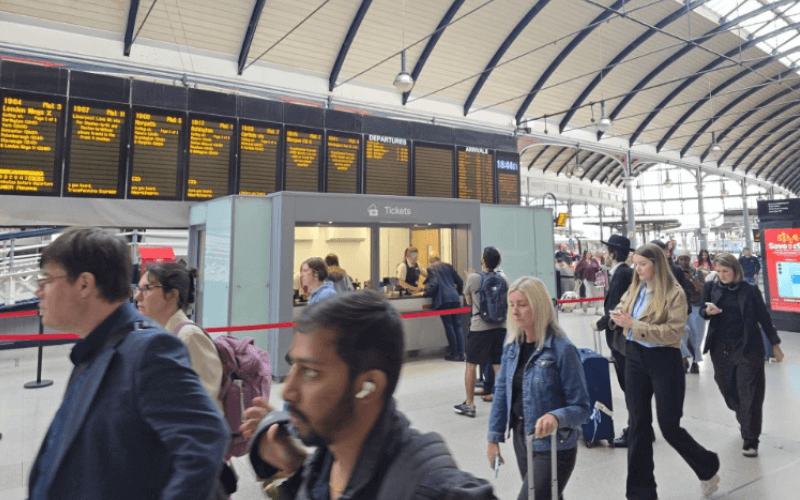
They spoke out this week after criticism of LNER’s move to replace the five-window ticket office at Newcastle’s main station with a small ticket kiosk (pictured) in the middle of the main concourse that has just two windows for customers, supposedly backed up by roving “floor walkers” with “mobile devices”.
But the RMT rail union has also revealed this week how an official document shows an option to close nearly every ticket office on Transport for London’s west-to-east Elizabeth Line rail system by 2027.
The Elizabeth Line only opened three years ago but extracts from the document – seen by Disability News Service – suggest that Transport for London (TfL) could close the ticket offices of all “Operator Leased Stations” by 20 August 2027, which would mean those at all but the three major stations of Reading, Paddington and Liverpool Street.
TfL said the document was a long-term contract with the private sector GTS joint venture that runs the Elizabeth Line.
It said the extract details an option in the contract that examines how operation of the Elizabeth Line might change with future developments in technology, including in customer retail.
A TfL spokesperson said: “There are no plans to close ticket offices.”
But Emily Sullivan, co-founder of the Association of British Commuters (ABC), said: “Everything is called an ‘option’ and not a ‘plan’ until the time they implement it.
“What we know for sure is that, due to the level of public outrage on this issue, as much as possible will be done by stealth.
“Rail workers are, as usual, our best early warning system on these issues.”
Only six months ago, ABC warned that cuts to ticket office opening hours by three rail providers across England and Scotland – ScotRail, Southeastern and Great Western Railway – were just a forerunner of further reductions to come across the country, which would have a significant impact on disabled passengers.
In Newcastle, the North East Public Transport Users’ Group has already raised concerns about the impact of the closure of the ticket office on disabled people, because of lengthened queues and problems faced by those with hearing impairments.
ABC has secured an admission from LNER that the equality impact assessment (EIA) of the Newcastle plans was drawn up two years ago, with the first version completed just as a public consultation into the proposed closure of most ticket offices in England was ending.
Those national plans – later abandoned by the Conservative government – would have had a “disastrous” impact on disabled rail passengers, campaigners warned at the time.
But ABC and the disabled people’s organisation Transport for All now fear that the Newcastle closure and other similar plans are part of an industry-wide move to find loopholes that will allow train companies across the country to close many of those ticket offices.
Sullivan said LNER’s kiosk was “the latest in a line of stealth methods being used to destaff ticket offices”, despite nearly 750,000 public objections to the proposed closures – 99 per cent of those who took part – in the public consultation in 2023.
LNER told ABC in response to a freedom of information request that the move in Newcastle to a ticket kiosk was just a “relocation” and so it did not need to consult the Department for Transport under Ticketing and Settlement Agreement regulations or take account of the impact of the change on accessibility and queuing times.
Sullivan said: “If LNER gets away with closing its ticket offices, it will give the green light to the rest of the railway to start exploiting these methods.
“We could then be seeing a co-ordinated attempt to destaff stations and ticket offices across the network.”
Natalie Ashton, senior engagement officer north at the disabled people’s organisation Transport for All, said: “Everyone needs to travel – for work, study or leisure – and ticket offices are crucial to that.
“They supply tickets for millions of journeys each year, and provide disabled people with information, access and assistance so that we can travel safely.
“The closure of the ticket office in Newcastle is unacceptable; it will prevent disabled people from travelling.
“Members tell us there are similar closures and understaffing from Yeovil to Scotland. This must stop.
“We need a national commitment to keeping tickets offices open and staffed, so that disabled people have the freedom to make the journeys we want to.”
RMT general secretary Eddie Dempsey said: “After the biggest wave of public opposition we’ve seen in years to ticket office closures, it’s beyond belief that similar plans are being put back on the table for the Elizabeth Line.
“Against the backdrop of industrial relations chaos across TfL, this reckless move is like pouring petrol on the fire.
“These offices are vital for thousands of passengers, especially disabled and vulnerable people who depend on face-to-face services.”
LNER declined to confirm that the Newcastle EIA dated from the time of the 2023 ticket office consultations, and that it has not been updated since then.
It also declined to explain what measures it had introduced to deal with the acoustics impact of the move to a kiosk, or to confirm that the move allowed it to avoid the usual regulatory processes when ticket offices are closed, and that the only approval for the plans came from Network Rail in March 2020.
But an LNER spokesperson said in a statement: “The ticket office has been relocated to the centre of Newcastle station to make it easier to find and available to as many customers as possible.”
She said the LNER customer accessibility forum had been consulted before the move and that its feedback “was taken into consideration”.
She said: “LNER colleagues are also now situated throughout the station, making assistance more accessible on the main concourse.
“Colleagues are available to help with customer queries, provide journey advice, or sell tickets using handheld devices.
“In addition, customers can purchase tickets from vending machines, with support available if required.
“This agile, more flexible approach enables colleagues to attend to customers more efficiently, reducing the need to queue and allowing them to provide support to those waiting in the Passenger Assist lounge.”
Picture by Simon Davison
A note from the editor:
Please consider making a voluntary financial contribution to support the work of DNS and allow it to continue producing independent, carefully-researched news stories that focus on the lives and rights of disabled people and their user-led organisations.
Please do not contribute if you cannot afford to do so, and please note that DNS is not a charity. It is run and owned by disabled journalist John Pring and has been from its launch in April 2009.
Thank you for anything you can do to support the work of DNS…
 Disabled activist obtains ‘extremely worrying’ emails that show ‘rotten culture’ within rail industry
 Transport for London finally admits it included contract option to close half Elizabeth line ticket offices
 Letter from MP and activists demands rights and accessibility improvements to railways bill