
Disabled people’s organisations have expressed shock and alarm at the disability minister’s “completely unacceptable” decision to impose gagging orders on members of his new “independent” advisory panel.
The panel, led by disabled campaigner Zara Todd, will advise Sir Stephen Timms and the Department for Work and Pensions (DWP) on disability benefits, employment and other DWP issues as part of efforts to “convene and connect” disabled people’s expertise with the department’s “policy design and delivery”.
Although all 10 members of the new Independent Disability Advisory Panel will be disabled people, they must all sign a non-disclosure agreement (NDA) that prevents them sharing information from their meetings outside the group.
This, DWP says, will ensure that “any sensitive information shared between the parties remains private and is not shared with others”.
Members will be paid £200 a day plus expenses for their work on the panel, which will only run until 31 March next year, although there is a “possibility” that it could be extended.
But the decision to restrict the panel to a maximum of 10 members, and particularly the need for those members to sign an NDA, has caused anger across the disabled people’s movement this week.
Dr Sally Witcher, a member of the advisory group for the last Labour government’s ground-breaking Improving the Life Chances of Disabled People report, and later deputy director of the new Office for Disability Issues and chief executive of Inclusion Scotland, said the government would have been “hard put to come up with a less transparent structure and process, more capable of being tightly managed and controlled, and therefore more likely to undermine trust” than the new panel.
Dr Witcher, founder of the social enterprise Inclusive New Normal, said that asking members to sign an NDA seemed to underline “how little this government trusts us” and could raise fears that the government believes that “no disabled person with integrity could support its actions”.
She said all the government had needed to do was include a confidentiality clause in a code of conduct, a common step taken by other independent advisory bodies.
She warned disabled people considering applying to the panel that “what looks like a valuable opportunity to promote engagement, influence and hold government to account may well instead be a way for government to close down dissent, tightly manage engagement, and avoid being held accountable, including legally”.
She said they would be “well-advised on this occasion, if they feel the urge to enter the lion’s den, to do so with extreme caution, and at their peril”.
The grassroots, user-led mental health group Recovery in the Bin (RiTB) was even more critical.
It said: “The moment anyone signs a non-disclosure agreement with the DWP is the moment a person betrays every single disabled person.”
RiTB also said a panel of 10 could not be representative of disabled people, and that it feared that those in the most “vulnerable” situations – those affected by mental ill-health or receiving the highest rate of out-of-work disability benefits – would not be included because of DWP’s benefit rules on earnings.
RiTB said: “Isn’t there a risk DWP won’t believe people who can be on a panel are not fit for work?
“This is why panels and reviews need to be independent.
“We were promised co-production and it clearly isn’t.”
Flick Williams, a disability rights campaigner and retired disability equality trainer and access consultant, said NDAs were “an instrument that allows those with power to silence those without”.
She said: “The justification given is that information will be shared that is not in the public domain, yet government needs to be transparent about proposed changes to social security.
“I would not be able to agree to withhold pertinent information from my fellow disabled people given the context of the oppression we face and will therefore not be applying for a place.”
She added: “A panel with only 10 members cannot hope to be remotely representative of the wide variety of impairment, health conditions and different circumstances experienced by disabled people.
“And whilst I believe disabled people should be paid for their time and participation in such initiatives, the way this panel is constituted is likely to deter those disabled people in receipt of universal credit and those with fluctuating conditions and the most severe chronic ill health.”
Fazilet Hadi, head of policy at Disability Rights UK (DR UK), said the “tone and nature” of the panel appeared to “continue the tradition of departmental secrecy” within DWP, and she said that asking disabled panel members to sign blanket NDAs was “completely unacceptable”.
She said: “Disabled people deserve transparency and accountability, especially when trust in government is at an all-time low following the universal credit bill.
“If it forces participants into secrecy, the panel will fail to build a bridge between DWP and disabled people, especially as there is no indication that views outside of the panel will be brought into the mix.”
Despite apparently only being paid for up to one-and-a-half days a month, the duties imposed on panel members appear to be time-consuming.
They will be asked to attend monthly workshops “to collaborate with policy teams in the department advising on the design and development of policy and strategy” and attend preparation meetings ahead of these workshops.
But they will also be expected to review departmental documents and may be asked to “share questions with their networks and gather wider feedback” for DWP.
The disabled people’s online activism community Disability Rebellion said the obligation to sign NDAs would create an “atmosphere of secrecy” and hide decisions from disabled people that would affect their lives.
Disability Rebellion said 10 members was “nowhere near enough to truly represent disabled people in a decision making process that will affect hundreds of thousands of disabled people”.
It also questioned whether £200 a day would be enough to compensate members for the work involved, when they were working a maximum of just one-and-a-half days a month, while any panel members on universal credit would “lose part of their benefits for doing the DWP’s dirty work for them”.
A DWP spokesperson said in a statement: “The purpose of the new [panel] is to convene the expertise of Deaf and disabled people and people with long-term health conditions into our policy design and delivery.
“To enable meaningful conversations, we may need to share sensitive information or information that is not in the public domain during discussions.”
Zara Todd said she could not comment on the NDA issue and the size of the panel she will be chairing, and she referred DNS to DWP.
But in a statement after her appointment last month, she said: “I’m delighted to chair the new Independent Disability Advisory Panel and help ensure Deaf and disabled people and people with long-term health conditions are heard in government policy-making.
“The panel will aim to strengthen relationships between the government and sector, and I look forward to working with other disabled people to connect lived experience with policy development.
“I hope that working collaboratively, we can build stronger links and build an approach that works for all.”
Todd is chair of Edinburgh Accessibility Commission, a member of the mobility and access committee for Scotland, a member of the British Council’s disability advisory panel, and convener of Disability Equality Scotland.
She has a long record of speaking out on disability rights issues such as independent living, accessible housing, and the rights of disabled women.
She previously worked with disabled people’s organisations including the Alliance for Inclusive Education, European Network on Independent Living, and Equal Lives, is on the board of Disabled Peoples’ International, and is a former chair of Inclusion London.
Meanwhile, an open letter calling for the review into personal independence payment (PDF) to be independently led by disabled people and their organisations – among other demands – rather than chaired by Sir Stephen Timms, has been signed by nearly 150 disabled people’s organisations, individual disabled people, and allies.
The letter, and campaigning around it, has been led by DPAC Cymru.
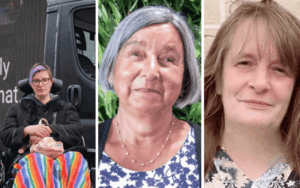
Picture: (From left to right) Dr Sally Witcher, Flick Williams and Fazilet Hadi
A note from the editor:
Please consider making a voluntary financial contribution to support the work of DNS and allow it to continue producing independent, carefully-researched news stories that focus on the lives and rights of disabled people and their user-led organisations.
Please do not contribute if you cannot afford to do so, and please note that DNS is not a charity. It is run and owned by disabled journalist John Pring and has been from its launch in April 2009.
Thank you for anything you can do to support the work of DNS…
 Budget is ‘miniature sticking plaster’, disabled people warn as they await Timms and Milburn reports
 Alarm bells ringing after minister says all work is good for health, and he wants ‘everyone’ to get a job
 PIP review member delivers powerful rebuttal to research by colleague that called for cuts to child DLA