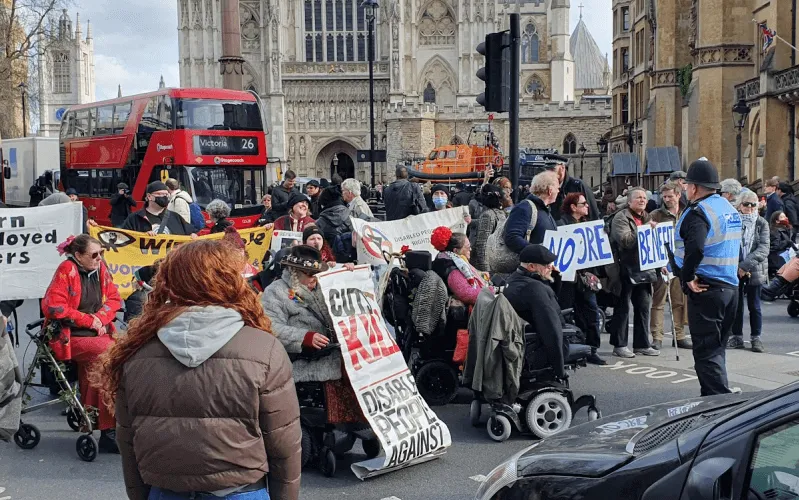
Disabled activists have come together to share ideas for how they can overcome the growing problem of “burnout” experienced by members of the disabled people’s movement who have spent years fighting oppression and hostility.
Friday’s event was hosted by disabled activist-academic Emma Hewitt, co-founder of Leeds Disabled People Against Cuts (DPAC), who is researching disabled activist burnout.
Hewitt, who has spent months talking to other activists and disabled people’s organisations as part of her work at the University of Manchester, said the last two years had been “particularly horrible” for many disabled activists.
She said: “There will be times when we are exhausted and overwhelmed and we are affected emotionally by what we are doing, and just affected emotionally by being in the world as a disabled person and how hard that is.”
She added: “We have to find a way to keep working together and support each other, especially when the world doesn’t support us.
“That solidarity in keeping together is what I am looking for in how we are going to manage burnout, so rather than how are we going to get rid of it, [we need to ask] how we are going to resist it.”
Earlier this year, disabled activists were involved in research which surveyed more than 130 respondents and found high levels of burnout among disabled activists.
That research found that younger activists tend to be more burned out, which “raises considerable concerns for the future of the Disabled People’s Movement in the UK”.
It concluded that the key drivers of burnout were not the activism itself but the barriers the activists faced “when confronted with ableism and the impact that ableist systems of oppression have on them”.
One disabled activist told Friday’s event in Manchester that immersing himself in the social model had often meant he ignored his impairment, but he had come to realise that, although it is difficult, “as a disabled person with an impairment you do need to look after yourself and recognise that your needs sometimes have to come first, rather than the activism”.
Another disabled activist, Laurel, said the burnout was physical as well as mental.
She said: “I had to go through a very hostile process of trying to fight for my disability rights… and then that impaired my health further, and then I had to go through the process of getting support and fighting the system for that support, and that impaired my health even further.
“Essentially, my being in a wheelchair today stemmed from the burnout of trying to fight a society that couldn’t even make accommodations for the less disabled version of myself, and now I’m more disabled.”
One veteran DPAC member, Sandra, told the meeting, hosted by Leeds DPAC: “Impairment is real and you can’t take that away.”
She said it was important to “recognise impairment reality” and use it to explain your own limitations and make it clear that “this is what I can’t do”.
She said: “It’s taken me a long time to get there.
“I have had to take time off because of a health reason, and I have really enjoyed myself not having to do stuff, not feeling it’s on my conscience that I haven’t been to this demonstration or this meeting.”
She said it was important that disabled activists do some things outside activism “that help us as people just to be people, just to actually get some pleasure out of life, because it’s very easy, as I’ve experienced in the last couple of years, to actually spend 100 per cent of my time on disability activism.
“I have recognised the need that I have to take breaks, and fortunately I am in an organisation [a branch of DPAC] where I am supported to do that.
“Being able to let yourself off the hook is vital to me.”
One activist told the meeting of the pressure he had been putting on himself and “almost a sense of overwhelming guilt… I am not doing enough here, I am not doing enough here, I am not doing enough over there.
“And you’re thinking: it can’t all be on me, I’m not the only person doing this and I can’t be held responsible… if we don’t get this changed or there’s a really regressive cut made, it’s not on one individual who didn’t go to a particular demo.”
A disabled activist-academic told the meeting that a possible cause of burnout for some disabled activists was the impact of “moral injury”, the feeling that “things should be just and they should be equitable” and yet an organisation – maybe even a disabled people’s organisation – could be acting in ways that are not equitable.
She said: “It’s an injustice from a space that should have been just, so it’s this feeling of the world being turned on its head, and you are kind of doubly harmed because, one, there’s the hurt that’s occurred, for whatever reason, but then it’s come from a space that should have been safe or it should have been accessible.
“When that happens as part of your activism, you start to feel like you have these insurmountable odds, you have this really difficult hill to climb, and it becomes super-exhausting.”
Hewitt shared a written statement prepared by the group of six disabled activists she has been working with on her research, most of them fellow DPAC members.
The statement says that many activists can experience burnout as feeling overwhelmed, exhausted and angry, as well as experiencing heightened sensitivity, reduced tolerance, emotional shutdown, and “a deep sense of disempowerment”.
And, they say, it can be worsened when they are “unheard, misunderstood, or gaslit by government and media”.
“We reject the idea that activist burnout is an individual psychological problem or deficit.
“Rather, burnout is a natural response to oppressive systems and to the emotional labour of caring in an uncaring world.”
They add: “We must support each other in finding what works, share labour within our activist communities, and accept that stepping back is sometimes necessary…
“By building compassionate, accessible, and inclusive spaces, and by centring joy, community, and connection, we strengthen activism itself.”
Disabled activists interested in contributing to an ongoing conversation about activist burnout can contact Leeds DPAC, while Disability Action Research Kollective is seeking contributors to its zine on the issue
 Free social care is coming… but only if you’re over 65, government confirms after Burnham speech
 Labour fails again on co-production as it reveals plan to ask disabled people to rubber-stamp disability strategy
 Disabled MP stays silent over key concerns as she says she will co-sponsor assisted dying bill