
Disabled activists have welcomed government plans to reduce the use of police cells as temporary “places of safety” for people detained under the Mental Health Act but have called for ministers to do more to prevent discrimination.
Home secretary Theresa May announced this week that a new police and sentencing bill would include measures to reduce the amount of time police have to spend dealing with people in mental distress.
It will include measures to cut the use of police cells for those detained under sections 135 and 136 of the act, reduce the maximum period of 72 hours that someone can be detained for a medical assessment, and enable more places – other than police cells and health settings – to be designated as “places of safety”.
The new legislation will ensure that under-18s are never taken to police cells if detained under sections 135 or 136, and that police cells can only be used as a place of safety for adults if their behaviour is “so extreme they cannot otherwise be safely managed”.
Last year, more than 4,000 people were detained under the act and held in a police cell rather than a health-based place of safety, of which at least 150 were under-18.
May said the government would provide “up to” £15 million of new funding to deliver health-based places of safety in England.
In a speech to the Police Federation’s annual conference in Bournemouth, she told delegates that “the right place for a person suffering a mental health crisis is a bed, not a police cell.
“And the right people to look after them are medically trained professionals, not police officers.”
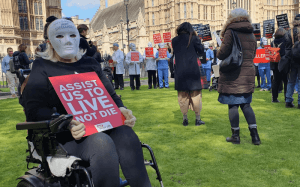
Roy Bard (pictured), a spokesman for the user-led grassroots organisation, the Mental Health Resistance Network (MHRN), said: “The MHRN welcome any move which reduces or ends the use of police cells as holding bays for people who are in serious mental distress.
“We remain concerned that people will continue to be unable to receive the help they need, due to the decimation of services, their continued underfunding and ongoing state discrimination against sufferers of mental health difficulties.
“We are keen to see what provision will be offered. We desperately want to see provision within dedicated hospital settings and continue to believe that accident and emergency departments are not appropriate settings for those in distress.
“We also firmly believe that there is a need for crisis centres that people can attend – or be taken to – for help.”
The Equality and Human Rights Commission (EHRC) welcomed the home secretary’s pledges, but called on ministers to go further, and implement all of the recommendations made in the commission’s inquiry report, Preventing Deaths in Detention of Adults with Mental Health Conditions, which was published in February.
The inquiry into non-natural deaths of those detained in psychiatric hospitals, prisons and police cells concluded that serious flaws within the mental health and criminal justice systems in England and Wales were responsible for the non-natural deaths of hundreds of service-users in detention.
The inquiry found that people were locked up in police cells inappropriately on more than 6,000 occasions because there were no places available for them in the mental health system. Some of these people subsequently died, often due to inappropriate restraint by police.
The EHRC inquiry made a series of recommendations, including a call for more “rigorous” systems to prevent basic mistakes; greater transparency and “more robust investigations”; and adopting the EHRC’s human rights framework in all three settings as “a practical tool to improve care”.
The human rights framework sets out steps to prevent deaths, including a duty to put in systems to protect lives, and to investigate any death for which the state may have some responsibility; freedom from bullying, staff neglect and unlawful physical restraint; effective risk assessments; and appropriate treatment and support.
Mark Hammond, the commission’s chief executive, said: “This is an important and welcome step in the right direction from the home secretary.
“There remains a lot more to do to tackle serious cracks in our systems of care for those with serious mental health conditions and we are looking forward to working with ministers to deliver further improvements.
“When the state detains people for their own good or the safety of others it has a very high level of responsibility to ensure their life is protected.
“For people with mental health conditions that is a particular challenge, with a large number of tragic cases over the past few years where that responsibility has not been met.”
A Home Office spokesman said the previous coalition government had implemented a series of measures to “improve the care people receive and reduce the burden on police officers”, which had seen the use of police cells for children and adults in mental distress fall by 22 per cent in 2013-14, compared with 2012-13.
He said the new measures announced by May were aimed at addressing the over-use of police cells and were just part of “a range of other work under way to address wider mental health and policing issues”, including a review of the use of sections 135 and 136 and a review by Her Majesty’s Inspectorate of Constabulary into the treatment of “vulnerable people in police custody”, which was commissioned by the home secretary.
He added: “We are also reviewing the use of force and restraint and police training, and the Independent Police Complaints Commission is undertaking work to improve its investigative response and liaison with families.”
 New Mental Health Act ‘offers no solution’ to abuse, exclusion and racism in mental health system
 Scottish and UK governments are failing to uphold disability rights, says watchdog
 Parliament has ‘dismissed and sidelined’ disabled people from assisted suicide bill debate, says letter