
Disabled union activists have appealed successfully to the TUC to support their fight against the government’s continuing attacks on disability benefits.
Two motions opposing Labour’s cuts and calling for campaign support from the TUC and its general council were passed unanimously at the annual TUC Congress in Brighton yesterday (Wednesday).
The first motion came from the TUC Disabled Workers’ Conference, and the second from the TUC Trades Union Councils Conference.
Alan Hackett, from the NASUWT teachers’ union, told TUC Congress: “The current government have made it very clear that they’re not going to just continue the war on disabled people, but they’re going to escalate it.
“Instead of increasing pressure on employers to make workplaces more accessible, the government has put the responsibility squarely at the door of disabled people.”
He added: “With united pressure, the trade unions, along with trades councils and disabled people’s organisations, managed to secure a significant stay of execution to the PIP changes.
“However, unless we maintain that pressure, that is all it will be.”
Natasha Hirst, from the National Union of Journalists, also appealed for support from the union movement.
She said the government was stripping away disabled people’s social security safeguards “without addressing the very real barriers that exclude us from employment and education and transport, health, housing, leisure, and everything else in our day-to-day lives”.
She said her union had supported members to challenge politicians who have undermined disabled people’s “humanity” and presented them as a “burden” while calling for cuts to disability benefits, and had called out regulators for not taking action on discriminatory reporting and broadcasting.
She said these attacks by politicians and the media had been “relentless and frightening”, while she warned of “more cuts to come”.
She told the conference: “Every disabled activist that I know is completely burned out right now.
“We have never needed your solidarity more, but more importantly, we need your action, including on behalf of disabled people who can’t work.
“It is a political choice to attack our rights; disabled people, and our organisations, need the full weight of the trade union movement behind us.”
Amy Bishop, from the Prospect union, said campaigning had been effective in securing government concessions on the bill to cut universal credit and personal independence payment (PIP).
But she said there were still “significant cuts” in the Universal Credit Act and although plans to cut PIP were removed from the legislation, the scope of a PIP review being led by Sir Stephen Timms was “wide ranging, with a target of making PIP sustainable to support generations to come, and I think we can all agree that this pretty much always means cuts”.
She said: “We cannot allow the government to decimate the support system for disabled people in the UK.”
Angela Hamilton, from UNISON, proposing the first motion, said the government may have made concessions on its initial PIP and universal credit cuts bill, but she told delegates: “Let’s be clear: we might have won the battle, but we haven’t won the war.”
She pointed to the appointment by the prime minister of the new work and pensions secretary Pat McFadden in this week’s government reshuffle (see separate story).
She said: “Don’t be fooled by Pat’s gently spoken, softly-softly approach. He’s been brought in to force through welfare reform and he is one tough cookie.”
Kate Bell, TUC’s assistant general secretary, said the TUC supported both motions and would consult with its general council on “the most effective and most accessible form of action to raise our voice against any further planned cuts and ensure that the voices of disabled workers are heard”.
Meanwhile, the Commons work and pensions committee has called on the government to reform the conditionality and sanctions regime facing benefit claimants.
In a new report on the government’s planned jobcentre reforms, it calls for the Department for Work and Pensions to “consider safeguarding and ‘trauma-informed approaches’ tailored to the personal circumstances of claimants” when making decisions about benefit sanctions.
Debbie Abrahams, chair of the committee, said there should be “significant personalisation of both the support claimants receive and the conditions of their job search.
“For example, someone with a health condition should not be sanctioned for not taking a job that they cannot do because of that condition just because of a one-size-fits-all approach.
“A more personalised, flexible approach will improve employment outcomes, give people more control over their lives and help to restore their dignity.”
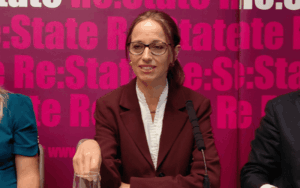
Picture: (From left to right) Amy Bishop, Alan Hackett and Natasha Hirst
A note from the editor:
Please consider making a voluntary financial contribution to support the work of DNS and allow it to continue producing independent, carefully-researched news stories that focus on the lives and rights of disabled people and their user-led organisations.
Please do not contribute if you cannot afford to do so, and please note that DNS is not a charity. It is run and owned by disabled journalist John Pring and has been from its launch in April 2009.
Thank you for anything you can do to support the work of DNS…
 Conservatives’ £1 billion Motability VAT plan will decimate scheme and raise almost nothing, figures show
 Leaked DWP ‘corner-cutting’ plans reveal changes to checks on assessments that will cause ‘even more risk’
 Information Commission orders DWP to release secret report that examined quality of PIP phone assessments