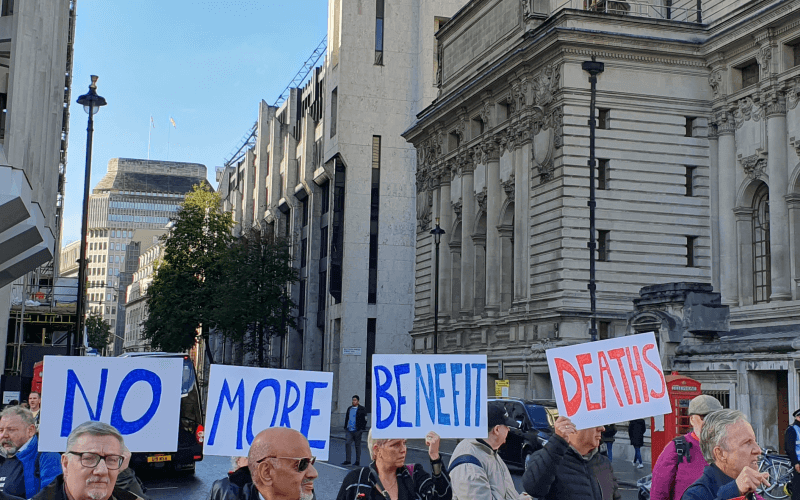
The minister for social security and disability has insisted that billions of pounds a year of cuts to disability benefits must go ahead, despite the risk that they will once again cause countless deaths of disabled claimants.
Sir Stephen Timms was giving evidence yesterday (Wednesday) to the Commons work and pensions committee about plans to cut billions of pounds a year from spending on personal independence payment (PIP) and the disability element of universal credit.
He was giving evidence to the committee’s final session of its inquiry into the government’s Pathways to Work green paper.
The first question he was asked, by committee chair Debbie Abrahams, was about the health impact of the cuts on disabled people, and whether the planned new employment support and jobs would be available by the time the government begins to implement the cuts next year.
She highlighted how research in 2015 by academics at Liverpool and Oxford universities showed the reassessment of disabled people on incapacity benefit through the work capability assessment was linked to about 600 suicides between 2010 and 2013.
Unpublished research also showed how cuts in 2017 – of nearly £30 a week to payments to new claimants of employment and support allowance who were placed in the work-related activity group (WRAG) – were associated with 130,000 “new onset mental health conditions”, she said.
Conservative ministers were ridiculed when they first announced the 2017 cuts and argued that they would “incentivise” those in the WRAG to find work.
Abrahams had already asked Sir Stephen what estimates the government had made of the impact the bill would have on health, in the light of these two pieces of research, at work and pensions questions on Monday.
He said on Monday that the Department for Work and Pensions was “working very closely with the Department of Health and Social Care to ensure that the health and care needs of people who lose benefits as a result of this process are met”.
And when asked again yesterday about the risk of harm caused by the bill, Sir Stephen said the government needed to make sure that both “employment support” and “health and care support” were in place when the cuts were implemented.
He said that new investment in infrastructure and jobs would be “coming into place” in the next few years, and with “what we are proposing on all of those fronts that we will be seeing the progress that we need”.
He added: “I don’t think it would be a viable option to say, well, we’re kind of not going to do anything about the health and disability benefits for a few years and see how things go.”
The minister was also asked by Liberal Democrat MP John Milne about government plans to halve the health element for new claimants of universal credit next year from £97 per week in 2024-25 to £50 per week in 2026-27, and to freeze it at £97 for existing claimants from 2026-27.
Sir Stephen claimed there was a “very big incentive” for disabled people to “seek to be classified” as having limited capability for work and work-related activity (LCWRA), and so eligible for the health element top-up.
He said: “If they are classified as LCWRA they get a premium which is worth more than the universal credit standard allowance, and that is unavoidably a massive magnet for people.”
He pointed to a letter he had seen in which an MP’s disabled constituent had said that being classified as LCWRA – rather than as having limited capability for work – would mean they would be paid £400 a month more, which would mean they would be “comfortable”.
But Sir Stephen Timms appeared to suggest that a disabled person being financially “comfortable” on benefits was a bad thing.
He said: “And I think this is a really serious flaw in the current system, that it presents this sort of LCWRA status as a sort of something to aim for, that ‘if only I could get to that, I would be comfortable’, when the system should not be doing that to people.
“That is a very bad feature of the current system.
“What the system should be doing is encouraging people to aspire to work and providing the support to make work possible and feasible, and so, yeah, we are wanting to substantially reduce that incentive.”
He said this would partly be done by raising the standard allowance of universal credit by £5 a week, as well as reducing the health element.
But Milne suggested that the government was concentrating on “Treasury first, needs second”, when what it should be doing was focusing on “needs first, Treasury second”.
*The Department: How a Violent Government Bureaucracy Killed Hundreds and Hid the Evidence, DNS editor John Pring’s book on the years of deaths linked to DWP’s actions and failings, is published by Pluto Press
A note from the editor:
Please consider making a voluntary financial contribution to support the work of DNS and allow it to continue producing independent, carefully-researched news stories that focus on the lives and rights of disabled people and their user-led organisations.
Please do not contribute if you cannot afford to do so, and please note that DNS is not a charity. It is run and owned by disabled journalist John Pring and has been from its launch in April 2009.
Thank you for anything you can do to support the work of DNS…
 Scores of DWP failings linked to deaths were kept from MPs voting on benefit cuts, secret reports reveal
 DWP staff ignored rules on how to respond to claimants who report suicidal thoughts, secret reports reveal
 Changes to energy bill discount scheme will discriminate against many disabled people, campaigners warn