
Kemi Badenoch and her Conservative party are being investigated by the statistics watchdog for repeatedly making misleading statements about social security spending, while they are also facing a possible examination into a second set of false claims.
Members of the shadow cabinet have repeatedly made statements about spending on social security that can easily be proven to be misleading or untrue.
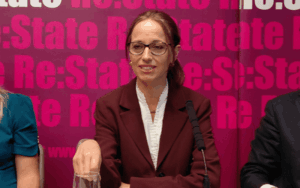
Now Disability News Service (DNS) has been told by the Office for Statistics Regulation (OSR), the regulatory arm of the UK Statistics Authority, that it is investigating claims made by Tory leader Kemi Badenoch (pictured) and other senior figures in her party.
DNS has now tried five times to secure explanations from the party for a series of claims it has made about social security spending – particularly on disability benefits – in recent months, including the one OSR is investigating.
OSR is now also looking into a second concern that was passed to it by DNS this week.
The first case concerns the claim made by party leader Kemi Badenoch and other senior party figures that “welfare spending is higher than income tax revenue for the first time ever”.
As the fact-checking charity Full Fact has shown, that claim is demonstrably untrue.
Full Fact has shown instead that welfare spending has been higher than income tax receipts every year for at least the last 13 years, and that 2025-26 is “expected to be the last for the foreseeable future that welfare is higher than income tax in the UK, not the first”.
The second concern, passed to OSR by DNS, relates to the often-repeated claim that spending on benefits is “out of control”.
One of the most recent examples of its use came from Helen Whately, the shadow work and pensions secretary, who told MPs during last month’s debate on the king’s speech that the “benefits bill is out of control”.
Others to have made similar claims include former work and pensions secretary Mel Stride, now the Conservative shadow chancellor, who has claimed that the “welfare bill” was “spiralling out of control”.
In fact, as DNS has repeatedly reminded politicians, Office for Budget Responsibility figures show that total spending on social security as a proportion of GDP* is roughly stable and is predicted to be at the same level in 2030-31 as it will be in 2026-27, at 11.2 per cent**.
An OSR spokesperson told DNS this week that it was “already considering some of the concerns you have flagged”, and he later clarified that this related to the claims debunked by Full Fact, which have passed its “initial review”, with OSR now “considering next steps”.
OSR is also now reviewing the concerns passed to it by DNS that relate to the party’s repeated claims of “out of control” benefits spending.
The Conservative party has failed five times to provide explanations to DNS for the two concerns being investigated or reviewed by OSR.
Meanwhile, the party has also refused to explain how Whately produced figures – also shared with MPs during the king’s speech debate – that she said showed 16,000 households are receiving more than £60,000 in benefits a year, or to examine why disabled people in these households might need that level of support because of their substantial support needs.
Another concern put to the party is the claim – repeated by Whately during the king’s speech debate – that the state is funding “free cars for tennis elbow or acne”.
This refers to the Motability scheme, but the Conservative party has so far refused to explain whether its senior figures genuinely believe that someone can receive a Motability vehicle in exchange for a claimant’s enhanced mobility rate of personal independence payment if they have a mild case of tennis elbow or a few spots, and no other health conditions.
Whately, and her party, have been unable to provide any evidence of a single case of someone in such a position who has managed to secure a Motability vehicle.
Finally, Whately and her party have been unable to provide any evidence to show that disabled people receiving significant amounts of benefits do not need them, when disabled people are significantly more likely to be living in poverty than non-disabled people and face substantial levels of disability-related costs.
DNS has so far made five attempts – four by email and one by phone – to secure answers to these questions.
The only response so far has been a short email from a Conservative press officer that explained that forecast receipts from income tax would be lower (£331 billion) in 2025-26 than expected welfare spending (£333 billion), a fact which is not in dispute.
*Gross domestic product, the size of the country’s economy in a particular year
**See chapter four of OBR’s Economic and Fiscal Outlook – March 2026, table 4.1, which shows welfare spending as a percentage of GDP: https://obr.uk/efo/economic-and-fiscal-outlook-march-2026/
 Instagram, Facebook and TikTok fail to act on animations spreading hate and lies about PIP claimants
 Disabled people who rely on PIP face ‘constant fear’ that physical activity could see them lose their benefits
 Conservatives’ £1 billion Motability VAT plan will decimate scheme and raise almost nothing, figures show