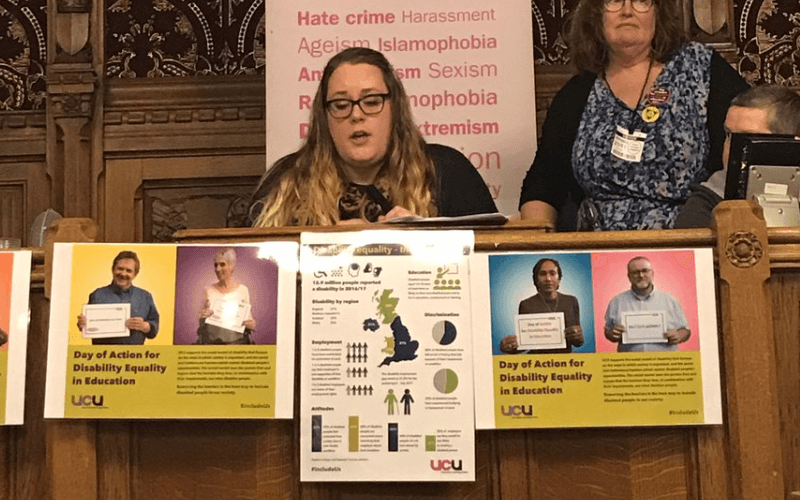
Disabled teachers, lecturers and students have come together to call for sweeping changes to disability equality laws, and to highlight the barriers they face across the education sector.
A parliamentary meeting heard last night (Wednesday) how disabled people working in the education sector have been confronted by employers that are failing to provide them with accessible lecture and teaching spaces, denying them the right to disability leave – for disability-related absence from work – and delaying the provision of the reasonable adjustments they need and are entitled to under the Equality Act.
The event, hosted by Labour’s shadow minister for disabled people, Marsha de Cordova, was part of the University and College Union’s (UCU) first national day of action for disability equality in education.
Joanna Vanderhoof (pictured), co-chair of UNISON’s eastern region disabled members’ committee, described how she had been forced to go through an internal grievance procedure to secure the reasonable adjustments she needed from her university employer.
She said she had been “fundamentally failed” by her employer and as a result set up a disabled staff network and implemented workplace training on disability equality.
She said: “My employer broke current legislation in multiple areas yet I’m the one who has suffered and they face no repercussions whatsoever.”
She said she felt “utterly trapped because I can’t move to another job easily the way others can because I am disabled”.
Vanderhoof said that current legislation was “simply not sufficient”.
Disabled physics teacher Saeeda Bugtti said she had gone from being a highly-praised “poster girl” for her school to being asked if she wanted to take early retirement, after she became disabled.
She said: “As soon as I became disabled, I was too much of a problem.”
She echoed other speakers who had described how long it took for reasonable adjustments to be agreed and implemented by employers.
Another disabled member of staff said it had taken his “affluent” university – which had a surplus of £200 million – one-and-a-half years to provide him with a telephone with an amplifier.
He said the current legislation was “toothless” and there was a need to campaign for “a more effective Equality Act”.
Elane Heffernan, chair of UCU’s disabled members’ standing committee, who chaired the meeting, said: “We have to win this change. We cannot have this silent massacre of workers in education and students who cannot even get in through the door in the first place in terms of education.”
The meeting also heard how further education colleges and universities, motivated by increasing pressure to cut costs and increase revenue, were refusing to support disabled students and even attempting to force then out because it was too expensive to provide them with the support they needed.
Rachel O’Brien, disabled students’ officer for the NUS, said there was an increasing “marketisation” of further and higher education, as well as cuts to disabled students’ allowance in higher education and the introduction of education, health and care plans in further education, which had also led to cuts in support.
She said the introduction of “fitness to study” policies – assessing whether someone can continue as a student by looking at aspects of their life on campus such as health, behavior and attendance – implicitly or even explicitly targeted disabled students, such as those with mental health conditions, and could see them kicked off their courses.
She said: “It is no coincidence that this has come in at the same time as marketisation.
“Disabled students, to be frank, are expensive. Universities and colleges are being forced to be businesses.
“They have incentives to get rid of us, and they are trying to do it as fast as they possibly can.”
Among UCU’s demands are for legal rights to disability leave, a review of building regulations to ensure facilities are fully accessible, and strict time limits for reasonable adjustments to be provided for disabled staff.
Campaigners who have supported the UCU campaign – including other unions such as the National Education Union and Unison – also want a legal right for disabled people to access mainstream education and a reversal of cuts to special educational needs and disability (SEND) spending.
Michelle Daley, an inclusive education campaigner, said that disabled people should not be asking for “reasonable adjustments” but should be seeking “adjustments as a right” if that was what they needed to be able to function.
Simone Aspis, policy and campaigns coordinator for The Alliance for Inclusive Education, said: “Education funding has an impact on our right to access mainstream education.
“We are increasingly seeing attacks on provision of support and local authority support and disabled students’ allowance support in mainstream education.”
She said there was “more and more money being ploughed into segregated provision”, which amounted to an “ideological attack” on disabled people’s right to inclusive education.
Paula Peters, a member of the national steering group of Disabled People Against Cuts (DPAC), said: “It is so important that disabled people have role models but disabled staff within education settings are… under attack from workplace discrimination and worsening conditions at work, with experiences of hostile environments and isolation at work all far too commonplace. This is unacceptable.”
The idea for the day of action originally came from the union-funded National Disabled People’s Summit, which was held at the headquarters of the National Education Union in central London last November and was co-organised by the Reclaiming Our Futures Alliance.
The House of Commons event also coincided with the start of Disability History Month (see separate story).
Richard Rieser, founder of Disability History Month, told the day of action event that there was a need to “learn from the history” when it came to the increasing segregation of disabled children and young people, and he added: “We have the right to be treated with equality and challenge all the historic assumptions that have been made about us for many hundreds of years.”
The day saw UCU branches across the country organise activities to raise awareness about the issues faced by disabled staff and students, with support tweeted through the hashtag #IncludeUs.
One of those actions took place at the University of Liverpool, and involved disabled lecturer Dr Kay Inckle, who told Disability News Service in August how she had been forced to scour the campus for accessible rooms in which she could deliver her lectures.
She was even told that it might be considered “reasonable” for her to go down stairs on her bottom in some circumstances rather than be timetabled into ground floor or fully accessible rooms.
A note from the editor:
Please consider making a voluntary financial contribution to support the work of DNS and allow it to continue producing independent, carefully-researched news stories that focus on the lives and rights of disabled people and their user-led organisations.
Please do not contribute if you cannot afford to do so, and please note that DNS is not a charity. It is run and owned by disabled journalist John Pring and has been from its launch in April 2009.
Thank you for anything you can do to support the work of DNS…
 Government’s ‘generational’ SEND reforms will leave more children in segregated settings
 SEND reforms ‘are a missed opportunity’ to dismantle the barriers driving disabled pupils from mainstream
 ‘Appalling’ and ‘frightening’ Reform ‘ready to legalise discrimination’ by scrapping Equality Act