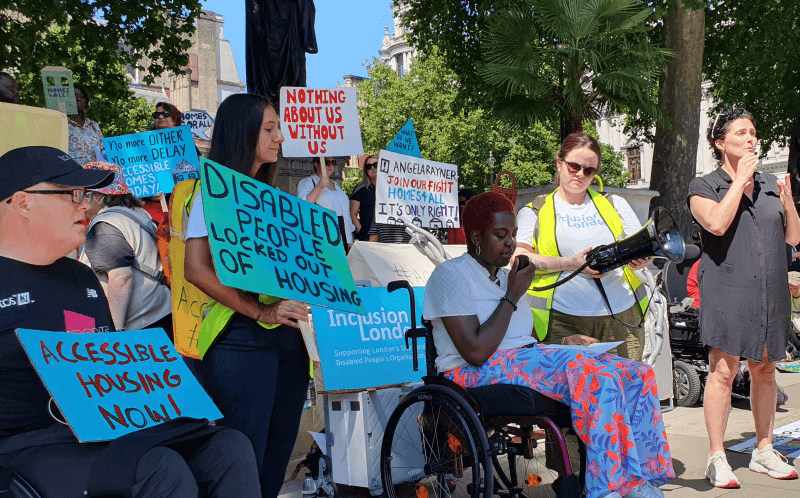
The Labour government has been accused of a “truly horrifying” betrayal of disabled people after slashing an accessible housing target proposed by the last Conservative government.
On 18 March 2024, Tory housing minister Felicity Buchan finally promised to introduce new rules that would ensure all new homes were built to the strict M4(2)* standard of accessibility, except for cases where this was “impractical and unachievable”.
Conservative ministers had been considering and consulting on the measure – a long-standing demand of the disabled people’s movement – for at least five years, but the general election came before any further action was taken.
This week, the Labour government – after more than a year of delays and false promises – finally published its own plans for accessible housing in a consultation on changes to the National Planning Policy Framework.
But the consultation shows that Labour wants to cut the percentage of new homes that should be built to the M4(2) standard from 100 per cent – under the Tory plans – to just 40 per cent.
Housing secretary Steve Reed said the new framework would “get Britain building” and “place the key to homeownership into the hands of thousands more hardworking people and families”.
But instead of supporting plans for all new homes to be built to a decent accessible homes standard, the consultation document says the government is “proposing a national minimum that ensures at least 40% of new housing over the course of the plan period is delivered to M4(2) standards”.
There will also be no minimum level for the proportion of new homes that are suitable for wheelchair-users, which disabled housing campaigners believe should be set to at least 10 per cent.
Chancellor Rachel Reeves said the reforms “back the builders not the blockers, unlock investment and make it easier to build the 1.5 million new homes across every region – rebuilding the foundations of our economy and making affordable homes a reality for working people once again”.
The government’s press release announcing the consultation includes a string of approving comments from the home-building industry.
Disabled people and their organisations now have the opportunity to deliver their response to the consultation, which ends on 10 March.
But Fazilet Hadi, head of policy for Disability Rights UK, has already accused the government of a “lack of principle” and betraying disabled people.
She said: “The announcement that only 40 per cent of new build homes need to be built to improved accessibility standards is truly horrifying, leaving disabled people feeling betrayed and excluded, and questioning the government’s commitment to disability equality.
“In a society where the number of disabled people across all ages is increasing and in which only a tiny fraction of homes are accessible, it is absolutely incredible to witness the government’s lack of principle and lack of forward planning.
“Requiring 100 per cent of all new-build homes to be built to improved accessibility standards with 10 per cent to wheelchair-user standards would have been the right thing to do, creating a level playing-field for developers and sending a strong signal that our housing stock must change, to meet the needs of our older and disabled citizens.
“The government’s failure of resolve and watered-down proposal leaves a bitter taste, raising questions about whose interests are being served.”
Inclusion London also criticised the move.
It said the government’s proposal “falls short of what disabled people need” and would leave thousands with unmet housing needs.
Laura Vicinanza, Inclusion London’s senior policy and stakeholder engagement manager, said the government had “pledged in their manifesto to champion the rights of disabled people” and “promised to work with us and put our voices at the heart of decision-making”.
She said: “We believe the government should follow the London Plan approach on accessible housing, where 90 per cent of new-build homes are planned to be accessible and adaptable and [another] 10 per cent to be wheelchair-accessible.
“This approach delivers far better outcomes for disabled people than other areas in England.
“We urge the government to reconsider their approach, listen to disabled people and develop ambitious planning policies that leave no one behind.”
Asked how Reed justified slashing the accessible housing target, the Ministry of Housing, Communities and Local Government had not commented by 11am today (Thursday).
*Homes built to the M4(2) standard have 16 accessible or adaptable features, similar to the Lifetime Homes standard developed in the early 1990s to make homes more easily adaptable for lifetime use, while M4(3) homes are those that are supposed to be fully wheelchair-accessible
 New DWP figures fail again to provide clarity on employment disadvantage faced by disabled people
 Budget extends the agony, as disabled people face further wait for Labour’s decisions on benefit cuts
 Budget is ‘miniature sticking plaster’, disabled people warn as they await Timms and Milburn reports