Disabled people’s organisations have labelled yesterday’s budget as “superficial” and a “miniature sticking plaster” as they wait with concern for the recommendations of two major reviews set to report to the government next month.
Measures announced by chancellor John Healey to address fuel poverty and food inflation were welcomed, but they have been seen as unlikely to make a significant difference to most disabled people struggling with food and fuel poverty.
Instead, every disabled people’s organisation that has spoken to Disability News Service in the last 24 hours has expressed concern about the final reports of the Timms Review on personal independence payment (PIP) and the Milburn review on young people not in education, employment or training, both of which will be published next month (November).
The government will respond to these reports by the end of this year, Healey said, with a white paper and legislation to follow next year.
Fazilet Hadi, head of policy for Disability Rights UK, said the budget did not include measures that would “directly penalise” disabled people, as it had last year, but would “nevertheless continue to drive disabled people in receipt of social security and/or low incomes into deeper debt and poverty”.
She said the energy payment of £100 to households in council tax bands A to D (with proportionate extra funding passed to the devolved governments in Northern Ireland, Scotland and Wales) “won’t touch the sides of bills set to increase by much more”, while the “pennies off food items [by suspending tariffs on more than 100 imported supermarket products] won’t significantly bring down the cost of the weekly shop”.
While removing standing charges for gas bills from next year “may help many disabled households, the impact on disabled people who have higher gas use could be negative”, while she said there continued to be “no targeted energy social tariff for disabled people with higher energy costs”.
She said the speech signalled cuts to disability benefits next year, which is likely to mean “proposals to cut benefits for young disabled people, restrictions to PIP eligibility and the replacement of contributory employment and support allowance with a time-limited unemployment insurance”.
Hadi said DR UK welcomed the plan to stop the “cliff-edge” rule for carer’s allowance, and replace it with a taper, so unpaid carers do not lose their entire carer’s allowance when they earn just one pound over the threshold.
Antonia Aluko, Inclusion London’s policy and campaigns officer, said July’s VAT cut on electricity bills and the budget’s £100 payment were “promising starts to addressing some of the fuel poverty concerns that we in the Disability Poverty Campaign Group have been urging the government to address”.
But she said the budget did not go far enough “in addressing the core issues disabled people have been campaigning on”, while she said they were also concerned at the hints of further cuts to disability benefits.
She said: “We maintain that cash benefits are necessary for many disabled people to be able to survive.
“The Timms Review was a first and modest step towards coproduction.
“We hope next year’s white paper responding to the Milburn and Timms reviews includes a thorough consultation process, in which disabled people and our organisations are heard.
“This is an opportunity for the government to genuinely commit to the principle of ‘nothing about us without us’ and support disabled people not just to survive, but to live with choice and independence.”
Kieran Lewis, rights and migration policy manager for National Survivor User Network, said Healey’s first budget had ignored mental health and said “very little” on disability, although NSUN welcomed the decision to scrap the carer’s allowance cliff-edge rule.
But he said it was “a budget of superficial tweaks that will do little to address the systemic drivers of mental ill-health in the long term”.
He said NSUN was “wary of the government’s renewed commitment to the use of artificial intelligence (AI) for NHS productivity”, and he added: “Our definition of a functioning health service must be informed by the experiences of patients and service-users, not the vested interests of the AI industry.
“As we know all too well – and as the recent Fonagy review admits – poverty and precarity drive distress.
“If the government were serious about addressing this, it would go beyond targeted support for energy costs and tax relief on imported food items.
“Instead, it would tax fossil fuel giants to bring our bills down, properly resource our health service and stop treating our welfare system as a source of savings for the Treasury.”
Dennis Queen, co-chair of Greater Manchester Coalition of Disabled People, warned of the cuts that are likely coming to disability benefits, even though disabled people know the benefits system is “brutal” and for many people “humiliating and even inhumane”.
She said: “Starving people out has never ever caused us to become non-disabled – it just breeds more health problems.
“Reforms for us always mean more cuts, studies become ways to justify those cuts.”
She welcomed the budget’s £100 contribution towards energy bills but said it was “a miniature sticking plaster”.
She said: “If the government thinks our bills are too high, then they should do something about the companies who are raking in profit, while others of us are running the financial gauntlet every day and parents are skipping meals.”
Healey also confirmed in the budget that the pledge to build a new National Care Service in England, with free personal care – funded by adjusting the pension triple lock – only applied to older people, telling MPs that the service would be there “when older people need it”.
Any action on the care charges working-age disabled people face will be left until after the final report of Baroness Casey’s social care commission next summer.
Queen said: “After so many years campaigning, the limits on free social care are painful.
“It’s a victory to have no charges for older people, we welcome it, but it’s nowhere near enough.
“Many of us can never pay off the debts incurred for needing the most basic help like washing and using the toilet.
“Us younger disabled people have no homes to protect and no end in sight. Our campaign for free social care has always been for everyone, not the few.”
Inclusion Barnet’s Campaign for Disability Justice welcomed the lack of any “real shocks” in the budget, and the £100 fuel payment.
Caroline Collier, Inclusion Barnet’s chief executive, said: “We were pleased that there were no real shocks in the budget, and an extra £100 for fuel for those in council tax bands A-D is welcome.
“However, we need to remain vigilant, as decisions may be made down the line in the light of the Timms and Milburn reports which do not support us.
“And more that that, what we need to see is some real vision and ambition around independent living and decent living standards.
“More than 20 years after [the last Labour government’s] Improving the Life Chances of Disabled People, we still await that level of focus and commitment to change from this government.”
Nik Hartley, chief executive of the Spinal Injuries Association, said: “We welcome measures that will help ease the financial pressures facing households.
“But for people with spinal cord injuries, poverty and the cost of living cannot be separated from the additional costs of disability.
“Keeping a home warm enough to remain healthy, running essential equipment, or accessing suitable transport are not choices or luxuries. They are necessities.
“No disabled person should have to choose between protecting their health and paying their bills.
“The government must recognise that equal financial support does not always mean equitable support.
“If we are serious about tackling poverty, we must address the additional and unavoidable costs that disabled people face.
“With further PIP reform now on the horizon, the government has an opportunity and a responsibility to ensure that the system properly recognises the additional costs of disability and supports people’s dignity, independence, choice, and participation in society.
“Reform must be driven by the realities of disabled people’s lives, not simply by the pursuit of financial savings.”
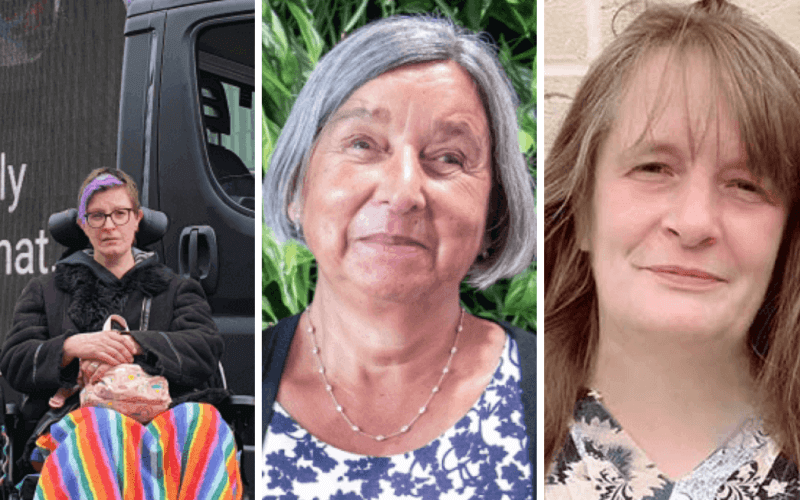
Picture: (From left to right) Dennis Queen, Fazilet Hadi, and Caroline Collier
 Budget extends the agony, as disabled people face further wait for Labour’s decisions on benefit cuts
 PIP review member delivers powerful rebuttal to research by colleague that called for cuts to child DLA
 Covid inquiry criticised for sidelining disabled people who received support at home in pandemic