A disabled woman who was left stranded on trains and station platforms more than 30 times by a rail company has been awarded compensation of £17,000.
Southern admitted repeatedly failing to deal with the discrimination Sam Jennings was facing, even after senior managers met with her and disabled campaigner Baroness [Tanni] Grey-Thompson in the House of Lords in January 2020.
Jennings, who was initially encountering the access issues while she was running her own flower stall at Norbury station in south London, tried again and again to persuade Southern to address its failings.
She first encountered problems within days of using a powerchair for the first time in August 2018, and soon began recording every incident on her mobile phone.
She told Disability News Service that, as a new wheelchair-user, the access failings she was experiencing felt like a “baptism of fire”.
She said she felt disabled by the attitude of Southern staff, and she would hear staff phoning colleagues and telling them: “There’s a wheelchair down here complaining.”
Others would just tell her it was not their job to help her.
She would find herself left on the train when she was trying to make her way to work at Norbury, or while heading to hospital appointments.
Despite her insistence that staff always phone ahead to her destination station, there would frequently be no-one there to assist her off the train when she arrived.
She was often forced to block the doors with her feet or her chair until fellow passengers could find a member of staff.
After months of access failings, and despite the House of Lords meeting, she finally decided that she would have to take legal action.
Southern has now agreed to pay her £17,000 compensation and to make several “specific commitments” on access.
She said she was “really excited” when she first heard of the settlement, but then she “cried for ages”.
She said: “Last night was the first time I realised that I feel vindicated for being so determined. I cried my eyes out. It hit me: how dare they do this to me.”
She said she had initially not wanted to involve lawyers because she considered some of the Southern staff were friends, after working with them for years, and she was convinced they would resolve the problems.
But a week after the House of Lords meeting, when she faced a particularly serious failure by staff at Clapham Junction, she realised that Southern “had not learned a thing” and she would need to involve lawyers.
She said: “The problem persisted because there is a culture at Southern of not giving a f***.
“There is no humanity there and they have been allowed to get away with it. It’s about attitudes and there is no accountability. They knew they would never get in trouble.
“From the beginning, I thought if I was one person encountering this many fails, how many disabled people are at home too terrified to go anywhere?”
She has already used some of the compensation to buy 10 new kettles and six microwaves for a local foodbank, while she is also buying herself a new foldable electric wheelchair.
She said: “No-one sets out to get involved with litigation and I saw legal action as a last resort.
“It wouldn’t have cost them a penny if they had listened to me.”
Among Southern’s pledges, it says it will investigate and record any failure to provide assistance, and it will provide disability equality training to all station staff by the end of July.
It also says that all relevant staff have been told how they need to call ahead to a destination station to ensure assistance is provided, with support from a new internal phone directory app.
Extra staff have also been deployed to help with assisted travel at Clapham Junction station, where Jennings encountered many of her problems.
Despite those pledges, Jennings said she was “not at all optimistic” that there will be real change.
But she said she hopes her legal victory will empower other disabled people to take similar action.
She said: “I want people to feel empowered to make a complaint because they are never going to stop otherwise.”
Her lawyer, Carrie Clewes, from the disabled-led legal film Fry Law, said Jennings had attempted – and failed – to resolve the case on many occasions before taking legal action.
She said: “Despite having Lady Tanni Grey-Thompson fighting her corner and calling a meeting at the House of Lords with Southern’s leadership team, again her requests and needs were ignored and [she] continued to have access issues.”
Even after Southern accepted its failings, and made some changes, she continued to experience access failings in the weeks leading up to the legal settlement, said Clewes.
She said that Southern “had no choice but to accept that they didn’t have the matter in hand, despite their assurances”.
Clewes said she hoped the case would help Southern realise its failings and implement the necessary changes.
She added: “If the claimant has had so many failings in one small part of the rail network, just how many of the disabled community are experiencing the same failings across the entire network?”
Chris Fowler, Southern’s customer services director, said in a statement: “We know we can do better and we are grateful for the discussions we have had with Ms Jennings which have helped inform how we can continue to improve.
“We take this feedback extremely seriously and it has been used to strengthen our accessibility strategy, which is already delivering significant improvements across our rail network.”
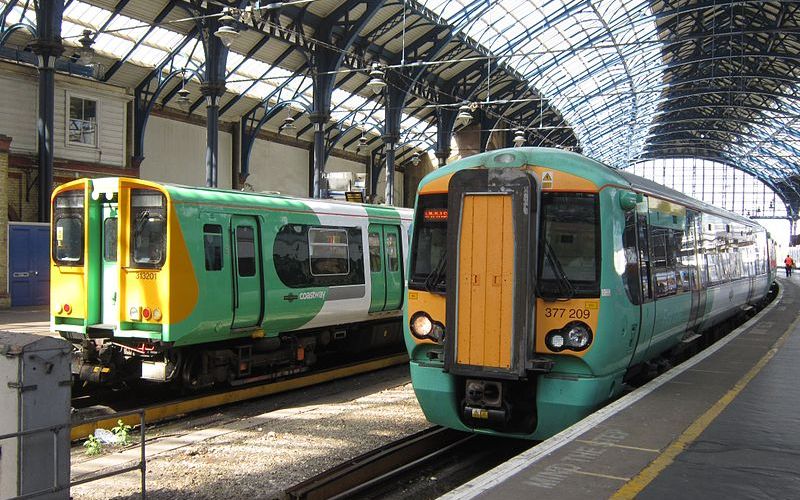
Picture: Two Southern trains
A note from the editor:
Please consider making a voluntary financial contribution to support the work of DNS and allow it to continue producing independent, carefully-researched news stories that focus on the lives and rights of disabled people and their user-led organisations.
Please do not contribute if you cannot afford to do so, and please note that DNS is not a charity. It is run and owned by disabled journalist John Pring and has been from its launch in April 2009.
Thank you for anything you can do to support the work of DNS…
 Tories discriminate against disabled editor by blocking DNS from receiving key information at conference
 Disabled MP faced discrimination twice in less than 24 hours after arriving in Brighton for Lib Dem conference
 Decision to order level boarding trains is ‘massive victory’ for disabled campaigners