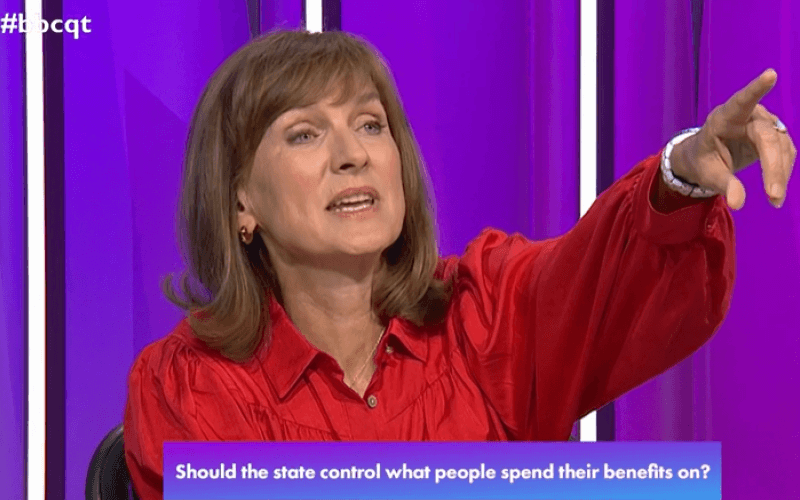
The BBC has failed to explain why the host of its flagship current affairs programme Question Time has repeatedly pushed the idea that social security spending must be cut, while ignoring official figures that debunk claims it is “spiralling”.
It is the latest attempt by Disability News Service (DNS) to hold the mainstream media to account for their repeated refusal to challenge politicians and commentators who repeatedly claim – wrongly – that spending on social security is out of control and so needs to be cut.
It was sparked by a discussion on last week’s Question Time, which featured Conservative shadow work and pensions secretary Helen Whately – who has been at the heart of spreading false claims about social security spending – explaining her party’s new policy on universal credit.
Under that policy, some claimants of universal credit would have their payments cut and would not be allowed to spend what was left on alcohol, betting or cigarettes.
During the discussion, Question Time host Fiona Bruce told Whately that the £500 million-plus savings were not “really going to touch the sides” of the total “welfare bill” before Bruce later challenged Liberal Democrat president Josh Babarinde to say whether he would cut spending.
Earlier this year, in a Question Time debate on whether “welfare” should be cut to fund increases in defence spending, Bruce told Labour minister Baroness [Jenny] Chapman: “Labour has tried to get through cuts in welfare and failed, thanks to a rebellion by backbenchers.
“I mean [and at this point she sighed], do you think it should be cut and do you have any chance of actually getting it cut?”
Bruce (pictured) later said: “Do you think on principle that welfare should be cut if we are actually spending more on welfare than we are raising in income tax?”
Earlier that day, the fact-checking charity Full Fact had debunked Tory claims that the UK was spending more on social security than it received through income tax for the first time, and showed that after at least 13 years when social security spending was higher than income tax revenue, the position was about to be reversed.
And last November, in a Question Time debate on that week’s budget, when an audience member said the government “appears to have no prudence at all”, Bruce suddenly asked: “And what would you rather have seen, less on welfare benefits?”
A BBC spokesperson said this week: “The level of social security spending is the subject of much political debate, and a complex issue.
“On the 24 September episode of Question Time, it was discussed in the context of the Conservative party’s recent welfare pledges, and a wide range of views was discussed during the panel discussion.
“For all the stories we report on across BBC News, we always try to reflect the relevant context and facts, and the different arguments.
“All feedback on how we cover issues is valuable, and this feedback has been passed to the relevant news editors.”
Meanwhile, Labour’s new chancellor, John Healey, became the latest politician to make a misleading statement about levels of social security spending in his speech to the party’s annual conference in Liverpool.
Hours later, the minister for social security and disability appeared to disagree with his position.
Healey had told the conference that it was “simply not progressive to allow a bigger and bigger benefits bill and a system which offers an income but doesn’t offer a future” and described it as a “moral duty” to reduce that bill and solve the problem of “a million youngsters with no work and no training”.
But Sir Stephen Timms later told a fringe meeting hosted by the IPPR thinktank and the National Centre for Social Research that the UK does “not have a generous system by international comparison” when it comes to benefits for people of working-age and children.
He said: “Contrary to the impression very often given… spending on this cohort is not exploding, it’s about between 10 and 11 per cent… and I think it’s been at that level for quite a long time now… it is not particularly high in historic perspective.”
He added: “We need to make the case that social security has a very important job to do.
“Social security plays a very important economic role as well as a very important social justice role and we do need to find new and compelling ways to win all the arguments around this.”
Guardian columnist Polly Toynbee – a former BBC social affairs editor – said the “extraordinary malice and spite at the moment against welfare is quite phenomenal and very shocking”.
She told the fringe meeting: “The overall bill is not high and it’s not surging.
“Every time there’s an interview, whether it’s Laura Kuenssberg or Nick Robinson [both BBC] or whoever, [they] always question what are you going to do about the surge in welfare, how are you going to cut welfare.”
She added: “I think it’s extraordinary that we are seeing the downward spiral with Jenrick [Reform UK’s Treasury spokesperson] and [Tory leader] Kemi Badenoch week by week outdoing each other for nastiness, [to see] who’s got the tightest thumbscrews.”
This summer, DNS reported how people’s organisations (DPOs) across the UK had suggested a range of ways in which they and their allies could fight back against the “deeply concerning” rise in hostile media coverage that is targeting disabled people.
It followed a series of dehumanising and disablist reports, columns and broadcasting segments.
They included a column by Jeremy Clarkson in the Sunday Times, in which he compared disabled benefit claimants to dogs; a column in The Times by Kathleen Stock, in which she questioned why many young women were using walking-sticks; and a column by disabled journalist Michael Simmons, who asked why young disabled people should view disability as “a badge of pride”.
Last year, broadcaster GB News insisted it had nothing to apologise for after a right-wing commentator and comedian suggested the best way to cut the number of disabled people claiming benefits was to starve or shoot them.
And broadcasting watchdog Ofcom cleared Talk TV over comments made by journalist Isabel Oakeshott, who had described some young people on disability benefits as “parasites”.
Among the ideas DPOs suggested were for disabled people and their organisations to pressure Ofcom and the news regulator IPSO; for DPOs to offer disabled people media training; and for DPOs to take coordinated action in response to hostile coverage.
 Whately appears to agree social security spending is not spiralling after all… as Tories plan £36 billion-a-year cuts
 DWP silent after Tory member of PIP review publishes report demanding child disability benefits are slashed
 Ministers’ decision to slash accessible housing targets was ‘unprincipled’, but Timms says they were right