Disabled campaigners have questioned the government’s decision to appoint a senior rail executive as one of its new disability and access ambassadors.
Alison Smith, the accessibility and inclusion lead for the Great British Railways Transition Team, who previously had a similar role at Network Rail, has been appointed as the rail ambassador.
Although the appointment was not announced on the website of the government’s Disability Unit, it was released on social media.
Among those questioning the appointment was Doug Paulley, who has spent years successfully challenging the rail industry over its access failures.
He described her appointment as “a terrible joke”.
He told Disability News Service of an incident that took place several years ago, after he had complained about two Network Rail employees who made abusive comments about him on social media.
He said Smith had asked him to read out the abusive messages in a meeting, and later, after Network Rail agreed to address his concerns, she failed to take any significant action to ensure those measures were carried out.
There are also concerns about comments Smith made in a parliamentary evidence session last year.
Just 12 months ago, she defended Network Rail’s practice of building new inaccessible footbridges, when she was giving evidence to MPs on the Commons transport select committee.
Last year, the public body, which owns and runs most of the country’s rail infrastructure, had admitted it would be building at least 17 inaccessible footbridges across England, Scotland and Wales in 2022, 2023 and 2024.
When asked to justify building inaccessible bridges, Smith told MPs that they were often in locations that could not provide power for a lift, and that ramps “can be very substantial bits of infrastructure not always supported by the community”, so Network Rail made decisions that were “in the best interests of the taxpayer”.
Paulley said these comments made her an inappropriate choice as the government’s new disability and access ambassador for rail.
He said: “I have absolutely no confidence at all that she will in any way champion disabled people’s rights.”
Sam Jennings, a disabled activist whose website #DisabledByTheRailway highlights the access barriers faced by disabled rail passengers, said: “The comments she made about inaccessible bridges just made me breathe fire.
“I just don’t see how someone who makes comments like that can be an appropriate choice as an access ambassador.”
She added: “It’s disappointing that we keep seeing the same names shuffled around the industry like a revolving door.
“There needs to be wholesale change and reform to the attitudes of everyone in the industry and it’s getting tiresome to see this never taken seriously enough.”
Flick Williams, a disability rights campaigner and retired disability equality trainer and access consultant, also questioned if Smith was “the right pick” for the role.
She said: “She forgets that railways divide communities, and inaccessible bridges impose a disability apartheid.
“The Equality Act is not something you can pick and choose from when it suits and ignore it when it doesn’t.
“If she doesn’t understand the importance of Network Rail being an inclusive, good neighbour to communities, perhaps she is not the right pick.”
In response to the concerns, a Network Rail spokesperson said in a statement: “We are delighted that Alison Smith has been appointed disability and access ambassador, representing the rail industry.
“With her extensive knowledge and experience as Network Rail’s head of customer strategy and now as GBRTT’s accessibility and inclusion lead, Alison will help build on the meaningful improvements in accessibility already seen across the rail sector, an understanding of the challenges faced and the commitment that rail travel should be accessible for everyone.”
There are currently 20 disability and access ambassadors, covering sectors such as advertising, arts and culture, banking, energy, housing, recruitment, retail and tourism.
The roles were created by the Conservative government to “drive improvements to the accessibility and quality of services and facilities in their sector for disabled people, as consumers and employees”.
But only a small number of the ambassadors chosen by the last government publicly self-identified as disabled people, and the Conservative government admitted that it did not even ask them if they were disabled people.
Disability News Service asked the Cabinet Office last year in a freedom of information request how many of its ambassadors identify as disabled people, and how many declined to provide that information when applying for the roles.
It replied: “Thank you for your request regarding the self-identification of the Disability and Access Ambassadors as disabled.
“This information is neither sought nor collected.”
The last government had claimed that its heavily-criticised National Disability Strategy would remove barriers to disabled people’s participation in public life.
Sir Stephen Timms, Labour’s new minister for social security and disability, said in November that he was looking for ambassadors who were “ambitious, passionate and dynamic, with strong networks in their sectors and the ability to reach out to a wide range of organisations to create momentum for change”.
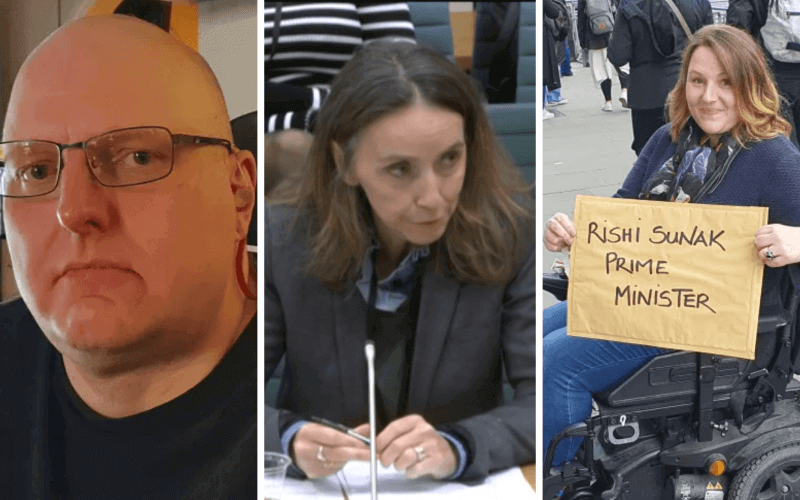
Picture: (From left to right) Doug Paulley, Alison Smith and Sam Jennings
A note from the editor:
Please consider making a voluntary financial contribution to support the work of DNS and allow it to continue producing independent, carefully-researched news stories that focus on the lives and rights of disabled people and their user-led organisations.
Please do not contribute if you cannot afford to do so, and please note that DNS is not a charity. It is run and owned by disabled journalist John Pring and has been from its launch in April 2009.
Thank you for anything you can do to support the work of DNS…
 Disabled activist obtains ‘extremely worrying’ emails that show ‘rotten culture’ within rail industry
 Shock and anger after DWP imposes gagging order on disabled members of its new advice panel