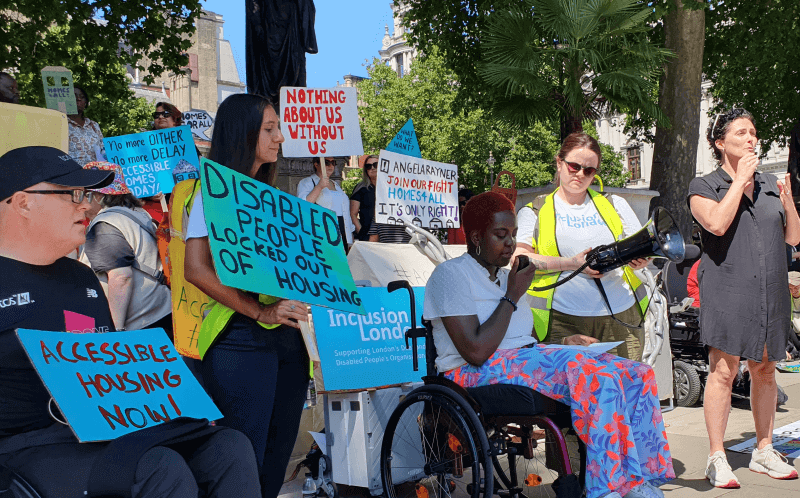
The government has been accused of losing its way on accessible housing, after refusing to explain why a report by its “taskforce” on delivering a series of new towns across England does not include a single mention of disabled people.
The independent report – commissioned by the government – recommends 12 potential locations for new towns across England, with at least 10,000 new homes in each location.
But the 135-page report contains only two brief references to the need for accessibility, either with the new homes themselves or the built environment surrounding them, and there is no mention of working-age disabled people.
One reference in the report says new towns should “include homes for older people, as well as specialist housing built to accessible and adaptable standards”.
The other says the mix of homes in new towns should include “homes for market sale, private rent, affordable housing, and specialist accommodation for students, families, and older people, all within a single coherent masterplan”.
Disabled people’s organisations that have been campaigning for action to solve the accessible housing crisis were critical of the latest failure by the Ministry of Housing, Communities and Local Government (MHCLG).
Mikey Erhardt, policy lead for Disability Rights UK, said: “It is unacceptable that, in 2025, a plan to deliver thousands of new homes, to tackle the housing crisis, will do nothing to improve the lives of disabled people.
“Relegating the needs of millions to a classification as ‘specialist’ shows just how entrenched ableist views are within the department.
“What is specialist about creating places that millions can actually call home, instead of the less than 10 per cent that disabled people can currently even visit?
“Yet again, we see a government department that has lost its way in trying to triangulate policy in favour of big developers and landlords, with disabled people as ever missing out.
“Talk about a missed opportunity; they’ve not even chosen to commit to a minimum number of accessible or wheelchair-accessible homes, let alone ensuring DDPOs* are included in the planning process.
“If our newest towns can’t be accessible, which ones will be?”
Last week, housing secretary Steve Reed announced that the government would build 12 of the new towns across England, but he and his party failed to make any pledge that accessibility would be central to their design.
More than 15 months after the general election, disabled people are still waiting for the new government to say whether it will introduce stricter minimum accessibility standards for new-build homes in England, three years after a pledge by the last Conservative government – which was never fulfilled – to take action to address the critical shortage of accessible housing.
Laura Vicinanza, senior policy and stakeholder engagement manager for Inclusion London, said: “The taskforce talks about accessible ‘specialist housing’, but accessible and adaptable standards must apply to all housing, so we’re not cut off from our communities.
“Housing with a baseline level of accessibility benefits us all – it allows us to stay in our homes longer as our needs change and we age.
“Three years ago, the Conservative government committed to raise the minimum accessibility standards for all new-build housing to the M4(2) accessible and adaptable standard, but they didn’t follow through.
“It’s time for Labour to commit to M4(2) accessibility for all new-builds, and for 10 per cent of new housing to be M4(3) wheelchair-accessible, focused in social housing.
“This is the opportunity to ensure that this wave of new housing and new towns doesn’t lock us out of safe housing for another generation.”
This week, Disability News Service (DNS) asked the government why the taskforce and its report had almost completely ignored disabled people’s housing needs, and the opportunity to build in accessibility across the new towns from the beginning; and why there was nothing in the taskforce report that sets a minimum level of accessible homes, including how many wheelchair-accessible homes should be built in the new towns.
DNS also asked for reassurance for disabled people that the government’s new towns plans would build in accessibility right from the start and from the ground-up, in co-production with disabled people and their user-led organisations.
MHCLG declined to explain why the taskforce report contained so few references to accessible housing and built environment in the new towns and failed to mention disabled people.
And it once again said it would set out its policies on accessible new-build housing shortly.
At last year’s Labour party conference, in September 2024, after DNS questioned the party on the failure of ministers to mention the accessible housing crisis, a Labour spokesperson promised the government would “set out its policies on accessible new build housing shortly”.
An MHCLG spokesperson said in a statement this week: “Everyone deserves to live in a decent home that is suitable for them and meets their needs.
“We will create New Towns that work for everyone, including disabled people, and we welcome recommendations from the taskforce that they should include specialist housing built to accessible and adaptable standards.
“We’re committed to working with disabled people and their organisations to shape these new communities together.”
*Deaf and disabled people’s organisations
A note from the editor:
Please consider making a voluntary financial contribution to support the work of DNS and allow it to continue producing independent, carefully-researched news stories that focus on the lives and rights of disabled people and their user-led organisations.
Please do not contribute if you cannot afford to do so, and please note that DNS is not a charity. It is run and owned by disabled journalist John Pring and has been from its launch in April 2009.
Thank you for anything you can do to support the work of DNS…
 SEND reforms ‘are a missed opportunity’ to dismantle the barriers driving disabled pupils from mainstream
 Inquiry hears how lack of accountability for disabled people’s Covid deaths caused lasting harm
 Government freezes funding for life-changing housing adaptations, despite minister’s claims