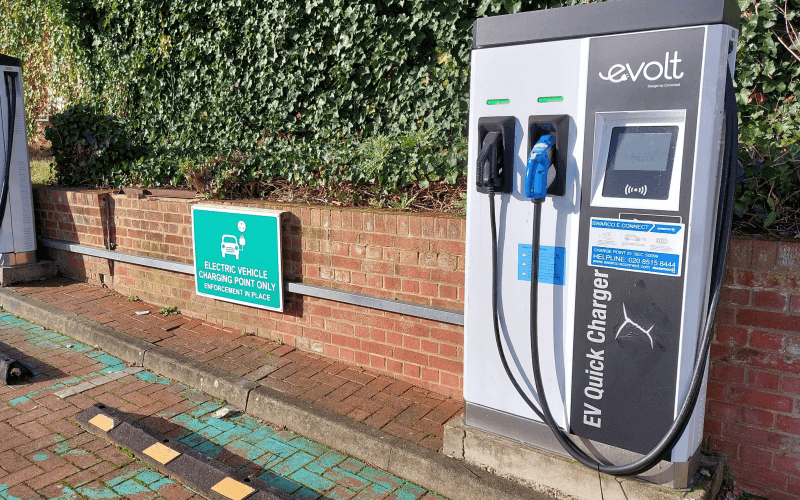
There is not a single public charging point for electric vehicles across the whole of the UK that meets the government’s own accessibility standard, a report by a committee of MPs has found.
The Commons public accounts committee said disabled drivers had been “left behind” in the rollout of public charge points.
Within 10 years, 1.35 million disabled drivers are expected to be wholly or partly dependent on public charge points.
But many charge points, or their surroundings, have features that make them inaccessible to some disabled drivers, such as being placed on kerbs or with obstructions, or due to the weight of the cable.
The Department for Transport (DfT) co-sponsored a new accessibility standard* for charge points – the world’s first national standard on the accessibility of electric vehicle (EV) charging infrastructure – alongside Motability Foundation and the British Standard Institution.
But two years on from its launch, DfT has not made its use compulsory.
Motability Foundation told the committee that there were still no charge points in the UK which were fully compliant with the standard.
DfT is currently working with the industry to review the standard to assess its implementation and understand how to improve its adoption, with the review set to conclude this spring.
The review’s findings could include examining action to align accessibility standards with other countries, which could help with the availability of components.
The Labour government has pledged to phase out new petrol and diesel car sales by 2030, with all new cars and vans to be zero emission from 2035.
But this shift to electric vehicles means a wide network of public charge points is crucial.
The committee’s report says that, while most drivers have driveways or garages where they can install a charge point for their private use, those without access to off-street parking rely on public charge points.
Public charging can cost three times as much as private charge points.
Motability Foundation told the committee that disabled people are less likely to own their own home and have access to private charging through off–street parking, so are more likely to face this financial penalty.
Graham Footer, chief executive of Disabled Motoring UK (DMUK), told Disability News Service: “The almost total lack of accessible public charging infrastructure is unacceptable and a stain on the EV industry, which has failed to make charging inclusive for all.
“DMUK is working hard to shine a spotlight on this issue.
“From research we have carried out, we know that 40 per cent of our members live in a dwelling that doesn’t allow for a home charger, meaning they will be totally reliant on public charging infrastructure.”
He said the failure to install accessible charging points was “appalling”.
He added: “If disabled motorists are expected to transition to electric vehicles, then accessible public charging infrastructure must be provided.
“Many of our members would be happy to switch to an electric vehicle but at present they are prevented from doing so because they cannot charge them.”
Sir Geoffrey Clifton-Brown, the committee’s chair, said it was “of deep concern that the needs of disabled drivers are being ignored.
“Not a single charge point in the country is currently fully accessible.
“We are risking baking a serious injustice into the fabric of a major part of our national infrastructure.”
The committee also found that the government had been slow to address gaps in charge point provision, and it raised concerns about regional differences.
About 73,000 public charge points were installed in the UK by January 2025, and while the government is set to reach the 300,000 DfT believes are needed by 2030, those that have been installed are not “evenly spread across the country”, with 43 per cent of them in the south-east and London.
Sir Geoffrey said the government “must move at pace to overcome current delays and encourage take-up, while taking the time to ensure no-one gets left behind in this all-important shift to the future”.
A DfT spokesperson said: “The government is dedicated to ensuring all electric vehicle drivers, including those with disabilities, can easily access public charge points that meet their needs.
“We are continuing to work with industry to increase adoption of standards for accessible EV charging infrastructure.”
*Electric Vehicles Accessible Charging Specification: PAS 1899:2022
Picture by Reading Borough Council
A note from the editor:
Please consider making a voluntary financial contribution to support the work of DNS and allow it to continue producing independent, carefully-researched news stories that focus on the lives and rights of disabled people and their user-led organisations.
Please do not contribute if you cannot afford to do so, and please note that DNS is not a charity. It is run and owned by disabled journalist John Pring and has been from its launch in April 2009.
Thank you for anything you can do to support the work of DNS…
 Ministers listen to disabled campaigners and return key accessibility duty to railways bill
 Disabled people warn of ‘severe’ consequences if chancellor removes Motability VAT exemption
 Chancellor’s reported plans to impose VAT on Motability could add £3,000 to even the cheapest cars