The government’s “independent” spending watchdog has refused to explain why it removed figures from its crucial budget forecast report that proved spending on social security is not spiralling out of control.
The move by the Office for Budget Responsibility (OBR) will help the government – and commentators – justify expected future cuts to spending, such as to personal independence payment and out-of-work disability benefits.
This week, the Sunday Times reported that the government was set to push ahead with plans, first proposed in March’s Pathways to Work green paper, to prevent disabled young people under the age of 22 from receiving the health element of universal credit.
And in a speech in London on Monday, the prime minister, Sir Keir Starmer, said that the social security system had “trapped people in poverty”, particularly young disabled people.
Her said young disabled people were being “simply written off” and trapped “in a cycle of worklessness and dependency for decades” which “costs the country money” and was “bad for our productivity”.
Disability News Service and academics, other journalists and disabled activists have been using the OBR figures since early this year to dismantle claims that “welfare spending” is increasing at an unmanageable rate.
But these crucial figures have been omitted from OBR’s latest Economic and Fiscal Outlook report, which was published last week alongside the budget.
The figures were first highlighted by a disabled activist in February, after they were included in the OBR’s October 2024 Economic and Fiscal Outlook.
The October 2024 figures showed that the share of GDP* taken by social security spending was stable, and was even predicted to fall from 11.1 per cent to 11.0 per cent in 2027-28 and 2028-29, before rising slightly back to 11.1 per cent in 2029-30.
Updated figures were included in an OBR report in March this year**, and they showed that social security spending was predicted to be even lower – as a proportion of GDP – than previously predicted.
The figures were included in one of the charts released alongside the Economic and Fiscal Outlook report, which is published alongside every budget.
That chart (chart 5.2) tracked “welfare spending” as a proportion of GDP for every year back to 2010-11, when it was 12 per cent of GDP.
But last week’s version of chart 5.2 was substantially different.
Instead of showing how spending has changed year by year since 2010-11 as a proportion of GDP, table 5.2 now shows how the proportion of government spending in different areas has changed relative to 2010-11 levels, making it impossible to compare social security spending levels year-by-year and prove that it has not “spiralled”.
What last week’s OBR report does show (see table 5.1 in the main report) is that the chancellor’s spending decisions – including scrapping the two-child benefit cap – have not led to an increase in the proportion of GDP being spent on social security, compared with previous predictions.
The figures show that welfare spending for 2024-25 was significantly lower than predicted last year (10.8 per cent compared with a predicted 11.1 per cent) as a proportion of GDP, while the predicted spending for this year is also lower than was forecast by the OBR last year (10.9 per cent versus 11.1 per cent), while the forecast levels for the next four years have remained unchanged.
These figures show that any attempt by media, civil servants and politicians – such as chancellor Rachel Reeves last year, DWP in January, and opposition MPs such as Tory leader Kemi Badenoch in September – to make false claims that social security spending is spiralling out of control would be misleading, if not deeply dishonest.
This week, OBR’s press office refused three times to even acknowledge emails asking why it had removed the historic figures from the report.
The Treasury had also not commented by noon today (Thursday) on whether it requested OBR to remove the historic welfare spending figures.
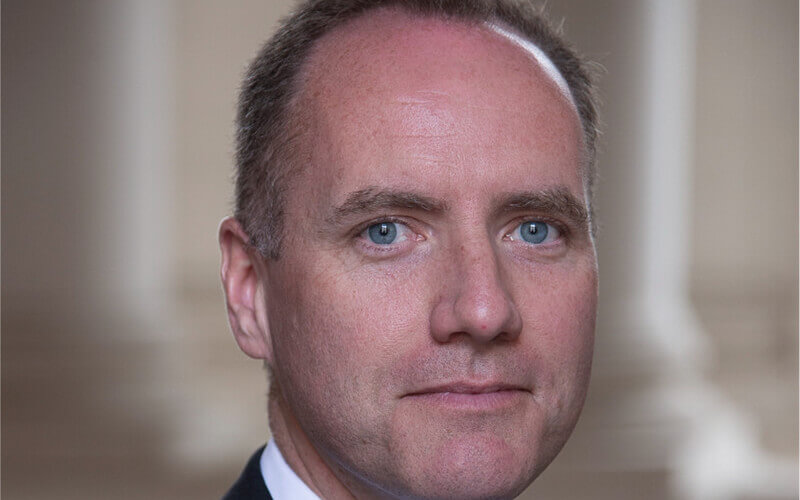
OBR’s refusal to comment came in a week that its chair, Richard Hughes (pictured), resigned after the watchdog mistakenly published its outlook report before Reeves had delivered her budget speech to MPs.
*Gross domestic product, the size of the country’s economy in a particular year
**Chapter five of OBR’s Economic and Fiscal Outlook – March 2025, chart 5.2, shows welfare spending as a percentage of GDP: https://obr.uk/efo/economic-and-fiscal-outlook-march-2025/
A note from the editor:
Please consider making a voluntary financial contribution to support the work of DNS and allow it to continue producing independent, carefully-researched news stories that focus on the lives and rights of disabled people and their user-led organisations.
Please do not contribute if you cannot afford to do so, and please note that DNS is not a charity. It is run and owned by disabled journalist John Pring and has been from its launch in April 2009.
Thank you for anything you can do to support the work of DNS…
 Scores of DWP failings linked to deaths were kept from MPs voting on benefit cuts, secret reports reveal
 DWP staff ignored rules on how to respond to claimants who report suicidal thoughts, secret reports reveal
 New official figures disprove claims that social security spending is ‘spiralling out of control’