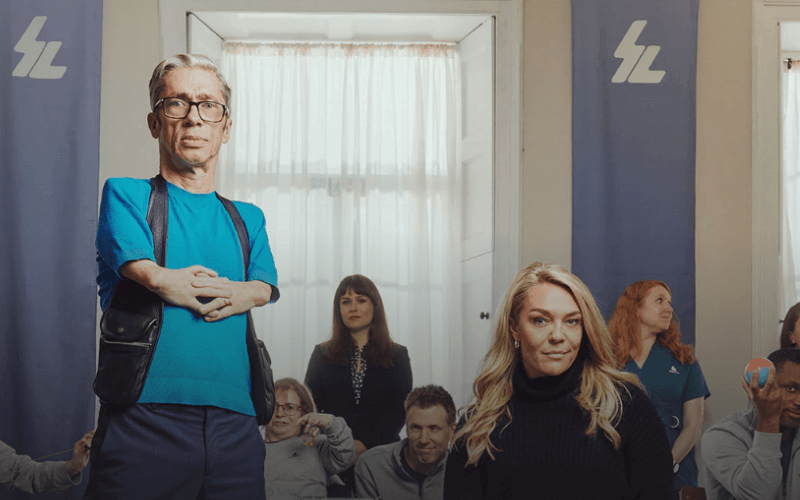
Disabled people have praised a shocking documentary “experiment” that exposes how Nazi ideology is being used to argue the case for cutting spending on disability support.
Although some disabled people who watched the Channel 4 documentary were horrified by the programme, most praised its “chilling” analysis and welcomed its suggestion that recent rhetoric by politicians and media about the cost of supporting disabled people has disturbing echoes of 1930s Germany.
Disabled film-maker, artist and writer Richard Butchins directed The Experiment, which also featured disabled presenters Sophie Morgan and Mat Fraser (pictured).
It was Butchins who came up with the idea to set up SegriLife House, a fake care home with disquieting branding and promotional materials, as a way to educate viewers about the Aktion T4 euthanasia programme in Nazi Germany that led to the killing of as many as 200,000 disabled people.
His idea was to invite members of the public to tour a new residential home for disabled adults and expose those visitors to increasingly-disturbing ideology as they watch staff and residents – played by disabled actors – go about their segregated, institutional lives.
The viewer is shown how the ideas behind SegriLife are drawn from those that motivated the segregation, dehumanisation and systematic extermination of disabled people by the Nazis.
The film also shows how modern-day rhetoric from government, media and politicians often provides chilling echoes of 1930s propaganda.
It shows one television commentator talking about the high numbers of people fraudulently “swinging the lead” who were “stealing from tax-payers”.
And it points to a British news channel that refused to apologise last year for allowing a right-wing commentator and comedian to suggest the best way to cut the number of disabled people claiming benefits was to starve or shoot them.
Butchins, whose memoir discussing disabled people’s media representation and authorship will be published early next year*, said: “The point of the programme was to say, ‘Look, these arguments are still being made, and if we just update all the materials, and produce some nice shiny posters and a nice shiny AI introductory video and a theoretically nice, shiny environment, we can just say the same thing and do the same thing again.’
“We did equate the current conversations around disability with the same argument that the Nazis were making: we’re a burden on society, we cost too much money, et cetera, et cetera.
“That is exactly the same argument the Nazis used, and it’s the same argument that’s used today.”
Butchins added: “We weren’t trying to expose the British public as heartless, anti-disability thugs, because they’re not, [but to show] how easy it was to convince them that this might be a good thing.”
He said The Experiment also showed that segregating disabled people – as happened under the Nazis – was the “thin end of the wedge”.
He said he was also pleased to be involved in a project that was “more or less authored by disabled people” and made it onto a major TV channel, and which featured 15 paid disabled actors.
Disability Rights UK said the documentary was a rare example of mainstream television highlighting the “deep-rooted ableism that runs through our society… where we are bombarded with political and media messages on being a burden and too costly to support and where we are labelled as fakers and skivers”.
It said the programme drew “strong parallels between Nazi ideology, which saw Disabled people as unproductive, costly and burdensome, and the political policies and attitudes towards Disabled people in the UK today”.
Among others who wrote about the documentary was disabled activist Dermot Devlin, who said he had initially been “deeply uncomfortable with the concept” but was glad he had watched it.
He said The Experiment had “chillingly” portrayed how some visitors to the institution seemed particularly interested in the money society could save by segregating disabled people.
He said: “What disturbed me most wasn’t simply the cruelty being portrayed. It was how easily some people accepted it.
“Even when disabled residents raised concerns, their voices were dismissed or silenced.”
One disabled activist who criticised the documentary was Simone Aspis, founder of Changing Perspectives, who said she felt the programme “trivialised” both what a Nazi regime would look like and disabled people’s experiences of cuts to their support today, and “didn’t do the issue justice”.
She said: “It was a very good idea and it could have been thought-provoking, but somehow it felt trivialised.
“It didn’t give enough attention to what people were saying. It needed to be more hard-hitting.”
But the Guardian’s Frances Ryan described the documentary as “disturbing, timely and surreal” and wrote: “It is excruciating and sinister and there is little let-up, the producers building the tension methodically as viewers witness dehumanisation being normalised in real time.”
In The Independent, Rachel Charlton-Dailey wrote: “The idea was to show how easily fascist rhetoric around disabled people being burdens to society could creep back in.
“The only problem is that I think these ideals never went away – and to act like they did only makes it easier for disabled people to be abused today.”
But she also said the programme showed how much media and government rhetoric “has hit home with the public”, and she highlighted how visitors to the care home “echoed soundbites that I’ve certainly read in newspaper columns and heard on radio talk shows about how much disabled people who sit around claiming benefits take from the taxpayer”.
There was widespread support for the documentary from disabled people on social media.
Ben Scott, who has previously written of the risk of dehumanising government policies allowing society to slide towards a repeat of the kind of atrocities perpetrated in Aktion T4, wrote on X that The Experiment was a “warning” and “exposes how easily dehumanising propaganda can normalise cruelty”.
Rhiann Johns wrote on X: “It was horrifying and devastating as I imagined and made me incredibly upset and angry but I thought it was such a thought-provoking and important watch.”
One of those who watched the programme described it as “a mind-blowing must watch”, while another said it was a “brilliant programme” that, as a disabled women, made her “more and more angry”.
And another of those who watched, April Dwyer, wrote: “As disabled people continue to face more and more hostility and ignorance, it is important that the public are reminded that the past can very easily repeat itself.”
*Misfits: Reframing Disability, by Richard Butchins, is due to be published by Pluto Press in February
 How to fight back against rising tide of hostile media coverage targeting disabled people
 DWP figures on total cost of disabled people who cannot work are ‘chilling’ echo of ‘useless eaters’ propaganda
 Channel 4 documentary on benefits was ‘atrocity’ and ‘insult’ to disabled people in poverty, say activists