Disabled people must push the government to introduce a national independent living service as part of radical reforms, and not just end care charges and rearrange the existing “fundamentally unjust” system, campaigners have told MPs.
The meeting in parliament on Monday evening was packed with disabled people – many of them users of council-funded care and support – and carers and allies.
It marked the publication of Inclusion London’s new Care Charging Unmasked report, which warns that the social care charging system is leaving many disabled people “trapped in silence, hardship, and fear”.
The report shows the system of charging for home care to be “fundamentally unjust”, with “deep-rooted and widespread failures” by local authorities when calculating how much disabled people should pay towards their support.
Tara Flood, a long-standing disabled campaigner against care charges, told the event that the government’s plan for a national care service was “an opportunity” but disabled people needed to push for more radical reform by calling for a national independent living service and “not simply a reorganisation of the existing care system”.
She said disabled people across the country were being charged for “essential support”.
She said this was discriminatory and the charges were “a tax on disability”, while the lack of funding for care and support was a national problem and it was “not the responsibility of disabled people to fill that funding gap” through care charges.
She said: “Article 19 of the UN Convention on the Rights of Persons with Disabilities recognises our equal right to live independently and to be included in our communities with the personal assistance we need to have choice and control.
“Independent living isn’t just about washing or dressing or eating, it’s about having a life: relationships, work, education, political participation, and friendships.
“Substantial charges reduce the money available for us to be able to do that, and when we can’t afford the support, our independence is threatened.”
Flood was a member of Hammersmith and Fulham Coalition against Cuts (HAFCAC), which spent 11 years campaigning for Hammersmith and Fulham council to end home care charging, which it did in 2015.
She said this success showed that charging was “a political choice” because councils have discretion over whether to charge for home care.
She said: “Hammersmith and Fulham chose not to because we organised, we campaigned, and we refused to accept the system as being fair.
“It shows what happens when disabled people are not simply consulted with but actually actively involved in shaping change.”
Kevin Caulfield, another HAFCAC member, said the meeting was an opportunity to “shine a light on what is the obscenity of charging”.
He said charging was a tax, and “a charge on just being who you are, your very essence as a human being, somebody who has some support needs”.
He compared the charging system to “a horror movie” and said disabled people were being “traumatized by the merry-go-round administrative processes, endlessly being assessed, reviewed, then immediately facing increased charges, then facing backdated payments, then potentially arrears”.
He added: “I don’t think we can morally means-test human rights for disabled people.”
Jade Hamnett, chair of ILG Community, a group of employers of personal assistants (PAs) across the UK, described how her local authority increased her care charges from zero to hundreds of pounds a month after it changed its charging system, providing less help and advice to disabled people and stopping supportive home visits for their financial assessments.
She fought a two-year battle – with Inclusion London’s assistance – over her council’s unlawful actions.
Hamnett said: “I can’t explain what it’s like to open each letter, either dismissing my arguments or telling me how much care debt I had now accumulated.
“That terror of not being able to afford care, the thought of having to stop the support that I desperately needed, and then what? Just fade away? Allow the debt to become unimaginable?
“I can’t tell you how many tears were shed over those two years.”
Eventually, she said, “the council accepted that it had been wrong all along and backdated its decision”.
But she said she was “one of the lucky ones”.
She said: “We hear from our members in my group for PA employers that people are having their experiences entirely dismissed, seemingly in the hope that they will stop fighting and go away.”
ILG Community has produced a “road map” that lays out a path to a right to independent living in England.
Giselle Hoad, an admin of the Adult Social Care Warriors Facebook group, has a disabled son who relies on council social care.
She told the meeting that the charges he faces mean he is not “allowed to put any money aside for his future, to build up savings, or even have a little extra for things that most people take for granted, like entertainment, going out, social activities, enjoying life.
“Why should being disabled mean that you’re effectively penalised financially for needing support?”
She said she heard constantly through the Facebook group from disabled people who were struggling with the care charging system.
Hoad said: “People are having to pay for the support that enables them to do the very things that most of us actually take for granted.
“And what happens when they can’t afford it? Some cut back on their care, some give it up altogether, some go without essential support because they simply cannot afford to pay for it.
“That isn’t independence, and it isn’t choice, and it certainly isn’t promoting wellbeing.
“I don’t believe disabled people should be means-tested and charged for the support they need to live their lives.
“Care is not a luxury, it’s not an optional extra, and it’s not something people should have to choose between: between putting food on the table, heating their homes, or having a social life.”
Gemma Peramiquel-Borjas said that dealing with care charges can become “a full-time job in itself” because of the work needed to respond to council requests and provide the information requested.
She said: “These barriers have a health impact which is accumulative and discourages you from getting the support you need.”
It was only when she lost her job and was exempted from charges because of her low income that she was able to organise her home to support her access needs, “figure out the best way to access the community”, finish her master’s degree, become a disability advocate at the disabled people’s organisation Choice in Hackney, and become an elected councillor on Hackney council.
The battle facing disabled campaigners who want to persuade parliament that there should be a national independent living service that is free at the point of use – while the government is apparently seeking ways to cut support through the disability benefits system – was illustrated by the failure of many MPs to turn up to the event, although at least three – Labour’s Neil Duncan-Jordan, Bambos Charalambous and the event’s host, Ben Coleman – did attend.
Coleman was deputy leader of Hammersmith and Fulham council and is now the Labour MP for Chelsea and Fulham, and a member of the Commons health and social care committee.
Hammersmith and Fulham is currently the only local authority in England* to have scrapped fees for social care at home, a policy it introduced in 2015 following years of activism by HAFCAC.
Coleman said he believed the door to scrapping charges nationwide was “a little bit more open” because of the prime minister’s push for a national care service, although currently Andy Burnham has only promised to remove personal care charges for older people.
He said that quality of care was also important, and scrapping charges did not guarantee “good quality of care”.
After hearing evidence at the meeting from disabled people and carers about their care charging ordeals, Flood told Coleman: “I hope you paid a lot of attention… because I think you’ve got a huge body of evidence to take to the health and social care committee that should be really pinning Andy Burnham up against the wall and saying, ‘A national care service needs to look like this.’”
Jon Abrams, Inclusion London’s campaigns and justice coordinator, who wrote the new report, said councils across the country were putting disabled people and carers through a “meat-grinder” with their care charging policies and how they pursue those who owe unpaid charges, often after receiving unexpected bills for years of backdated charges.
He said the problem was “very, very widespread and endemic”, with disabled people having to deal with a “Kafkaesque bureaucracy” that is “like playing a game where only the other side knows the rules” and council officers frequently “bend the rules” while being aware that disabled people and carers “don’t have access to the law” following years of cuts to legal aid.
He told the meeting: “Our report makes one thing clear: we don’t want to make the charging system a little less complicated or a little less unfair. We want to abolish it.
“We want a national care service funded collectively, providing support according to need and free at the point of use.”
Anne Pridmore, chair of the user-led organisation Being the Boss, which supports disabled people who employ personal assistants, told the meeting how her council’s decision to review her care package led to a 15-month ordeal that had a significant impact on her mental health.
She said the council now allowed her just £1.36 a month to replace her electric wheelchair when it came to disability-related expenditure** and had increased her care charges from £211 to £439 a month.
She said: “I have lost my appetite, and it has impacted every aspect of my life.
“I also find it very stressful opening emails or brown envelopes because I never know what the next message will contain or what further information or demands they will be making of me.
“Instead of feeling reassured, I feel anxious every time I receive correspondence from my local authority.”
She said care charges were “being used as a way of rationing social care” and that she had friends who had had to stop receiving support because the council had forced them into debt.
She told the meeting: “Social care should be free to working-age adults and older people.
“If Hammersmith and Fulham can do it, why can’t other councils?”
Journalist Claire Bolderson has previously worked with Inclusion London on research she carried out that exposed the financial hardship and emotional harm caused by care charges.
She told the meeting that charging was “a Wild West system” with “150-something councils all running their own care charging system, all different, and most importantly, none of them accountable to anybody”.
*Tower Hamlets council in east London briefly scrapped adult home care charges from April last year but has now reimposed some charges
**DRE refers to the extra costs disabled people face because of their impairments, such as increased heating bills, specialised dietary needs, and support with household tasks such as cleaning and laundry; local authorities must take account of these costs during a financial assessment to decide how much someone will have to contribute to their care and support
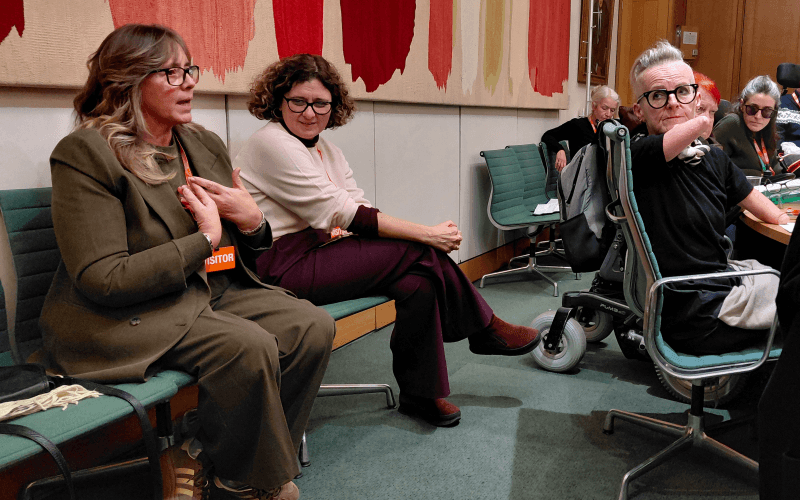
Picture: Tara Flood (right) listens as a carer speaks about her disabled son’s experience of care charging, watched by Inclusion London’s Svetlana Kotova (second from left)
 Disabled people’s organisations warn Timms Review ‘is hiding PIP cuts’ but welcome ‘rehumanising’ approach
 Five years of evidence exposes hardship and fear caused by social care charging system
 Budget is ‘miniature sticking plaster’, disabled people warn as they await Timms and Milburn reports