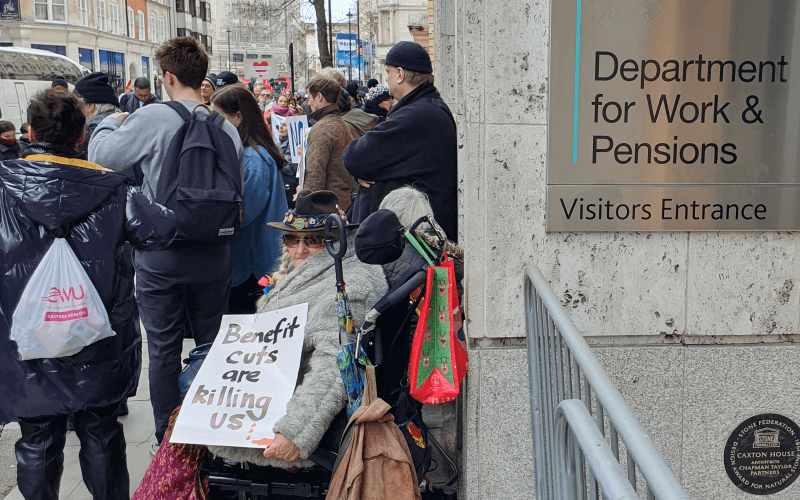
Disabled activists are to fight back against “cruel” and “unjustified” demands for huge cuts to disabled young people’s benefits in a report commissioned by the government which they say could have a “catastrophic” impact if introduced.
In a repeat of their anger and frustration when the Labour government tried to force cuts to disability benefits through parliament last year, a string of disabled people’s organisations have told Disability News Service (DNS) they will oppose the proposals.
The government looks set to accept most of the recommendations laid out in the 278-page report by former Labour cabinet minister Alan Milburn, which calls for cuts of more than 40 per cent to spending on disability benefits for young people within 10 years.
Milburn’s plans could potentially see some young disabled people with high support needs losing out by nearly £1,300 a month in lost personal independence payment (PIP) and universal credit health element payments – with many more seeing cuts of hundreds of pounds a month – as they are asked to survive on a basic allowance of just £338.58 a month.
Milburn also suggests – although this was outside the scope of his review – extending his ideas to all working-age disabled people.
The government has already “strongly endorsed” the core principles of the report, but it will wait for the final report of the Timms review into PIP – expected in the next fortnight – before setting out its “next steps on welfare reform”, with a white paper to be published early next year and legislation later in 2027.
Disabled People Against Cuts (DPAC), which was founded after the coalition government called for similar – although potentially less severe – cuts in 2010, said the measures proposed by Milburn were “cruel, callous, punishing”.
DPAC’s Paula Peters said the report had “no regard for disabled people’s safety” and would cause “poverty, homelessness and deaths” and place “further pressure on an already broken NHS and local services”.
She added: “I urge disabled people everywhere in the UK to join the fightback we are mounting against these cruel policies and join the resistance against the oppression of our human rights.”
DPAC said in a statement: “Young disabled people should not have to sacrifice their financial security, dignity, choice or control over their own lives to satisfy a political ambition to increase employment figures.”
Disability Rights UK said the cuts would “result in increases in poverty, destitution and homelessness, compounding precarity and worsening health and wellbeing outcomes”.
It said the proposals “set a dangerous precedent for the future of social security for disabled people, with government already discussing plans to expand the cuts proposed to over-25s and a complete rewriting of the principles of the welfare state.
“Government and parliamentarians must listen to young disabled people and disabled people’s organisations and reject cuts that will harm our lives.”
The cuts will now be at the centre of a protest from noon on Friday 4 December outside No 10 North in Manchester, which was already being organised by DPAC.
Dennis Queen, chair of Greater Manchester Coalition of Disabled People, told DNS: “Every time reforms like this happen, more of our people die and we can’t just put up with it.
“Protest and campaigning across communities has stopped these attacks in the past.
“We call on all communities to do our part to show the government that these attacks have to stop.”
The centrepiece of Milburn’s report is his call to scrap both PIP and the health element of universal credit for disabled people under 25.
Instead, all young claimants will receive a new youth allowance that would be set at the standard rate of universal credit (currently just £338.58 a month) and nearly all of them will face strict “obligations” to engage with a new, locally-run Youth Opportunity Service.
A “severe and complex needs insurance” should replace the health element of universal credit for under-25s, says Milburn, but only for the “small minority of young people with the most profound and long-term disabilities, where it is already clear they will likely never be able to work”.
Milburn says that “as few people as possible” should qualify for this new benefit.
PIP would be replaced by a government-run – non-means-tested – “additional costs allowance” to cover disability-related extra costs, but it would only be paid if these costs were “well established, significant, and ongoing”.
There would also be a “health and disability fund”, run by each local YOS, that would pay for some extra costs, such as the one-off aids and equipment needed while a disabled young person was receiving support.
In exchange for the cuts, all young people would have a legal entitlement to a place in education, training or work, and to the “health, employment, functional and practical support” they need to take advantage of those opportunities.
Julia Modern, senior policy and campaigns manager for Inclusion London, said the report “usurps” the Timms review of PIP, which has yet to be published, with Milburn concluding that PIP should eventually be scrapped for all age groups.
She said this made the effort to co-produce the Timms review “utterly pointless”.
But she said the scrapping of the universal credit health element, and tightly restricting those eligible for its replacement, would be “particularly harmful, because 75 per cent of people receiving this benefit are already living in deprivation”.
Modern said: “Make no mistake, while much of the new support for employment would be welcome and could genuinely lead to helping disabled people work, it is primarily serving as cover for an ideological blueprint that will decimate financial support for disabled people through the welfare state.
“The two things do not have to go together.
“The additional support is an investment that would eventually pay for itself through reduced benefits claims and increased tax receipts. It does not have to be tied to cuts.”
Dr Edmore Masendeke, policy and research lead for the Alliance for Inclusive Education (ALLFIE), which works closely with young disabled people, said: “ALLFIE is outraged that the Milburn review deepens social insecurity, undermines rights and reinforces a hierarchy of impairment, while failing to consider systemic and structural barriers or adopt an intersectional approach in any of its recommendations.
“Furthermore, the review ignores the fact that segregated education is one of the root causes of young disabled people’s exclusion from education, employment and training.
“If implemented, these recommendations will deepen poverty and perpetuate injustice for young disabled people.”
ALLFIE said the government was “punishing young disabled people for the government’s own failure to ensure progressive realisation of their rights” and risked further undermining their rights under the UN Convention on the Rights of Persons with Disabilities.
Amy Wells, head of communications and membership for National Survivor User Network, said the Milburn report “dresses up brutal cuts to social security for under-25s as part of the proposal to ‘help’ young people into work, setting a precedent for an approach to ‘reform’ that will eventually affect disabled people of all ages”.
She said: “We have grown impossibly tired of the idea that all work is inherently good for your mental health.
“Despite so many of us experiencing the exact opposite in employment, the government is intent on pushing this harmful and misguided narrative.
“[It is] so determined to save money that it is proposing to push disabled people into work without genuine support or structural change to the unavailability and inaccessibility of employment.
“There is still time to fight this, and as ever disabled people will come together to do so.”
Although the Milburn report is aimed at the whole of the UK, most of his recommendations would have to be agreed by devolved governments in Northern Ireland, Scotland and Wales before they could be introduced in those countries.
This is because education, skills, health and local government are devolved in all three, while some benefits are devolved in Scotland, and social security is devolved in Northern Ireland.
Tressa Burke, chief executive of Glasgow Disability Alliance, said: “The report fails to identify that the problem is not that too many young disabled people are receiving benefits; rather, the problem is that too many young disabled people face persistent and entrenched barriers that prevent them participating equally in society.”
She said GDA had “very real concerns that young disabled people will face pressures to engage with employment before the necessary supports are in place”.
She added: “Disability benefits recognise the extra costs many young disabled people face and help ensure those costs do not become barriers to everyday life which includes studying, working, volunteering, building relationships and contributing to their communities.
“Removing disability benefits will plunge young disabled people and their families into poverty and limit their opportunities. This is not the answer.”
Disability Wales called on the Welsh government to “respond robustly to the Milburn report and speak against its damaging proposals and scapegoating of disabled people”.
It said the report was “a thinly veiled attempt to cut £3.6 billion a year from disability and incapacity benefits”, creating a “two-tier system” by abolishing PIP and the health element for under-25s.
It said it was “very concerned that it will lead to a punitive system of sanctions for young disabled people perceived as disengaging from the process, creating a life-threatening cliff-edge where they could be left with no financial means to survive”.
And it warned of the report’s “ominous calls on the UK government to roll out this same model to over-25s”.
Nuala Toman, head of accessibility for Disability Action, in Northern Ireland, said: “Rather than targeting disability benefits, policymakers should focus on removing the barriers that continue to prevent disabled young people from accessing work such as inaccessible recruitment practices and poor transport links.
“It doesn’t matter what age a disabled person is, their day-to-day lives will likely cost more than others and PIP is intended to lessen that additional burden.
“We also note that some disabled people will not be able to work; our worth isn’t determined by our productivity and everyone deserves dignity and quality of life.”
 Government looks set to accept Milburn’s call for 41 per cent cuts to young people’s disability benefits
 Most Labour MPs appear to accept Milburn’s arguments for huge cuts to disabled young people’s benefits
 Burnham will evade questions from chair of work and pensions committee on Milburn and Timms reports