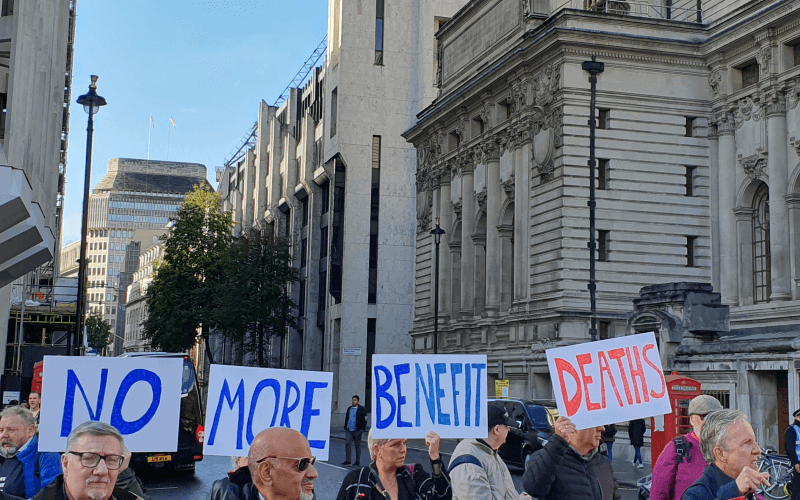
The health and safety watchdog has explained for the first time why it has never investigated the hundreds, and probably thousands, of deaths of disabled benefit claimants linked to the Department for Work and Pensions (DWP) over the last 16 years.
The Health and Safety Executive (HSE) says in its 10-year strategy that its aim is to “make a real impact on reducing death, ill health and injury” and to “inspire and influence everyone to keep pace with future change and collectively tackle the most serious risks to our society”.
Its website says it works to “ensure people feel safe where they live, where they work and in their environment”, while it describes itself as “Britain’s national regulator for workplace health and safety” and claims to be “dedicated to protecting people and places, and helping everyone lead safer and healthier lives”.
But despite these pledges, it has never investigated the years of deaths and other serious harm associated with DWP’s actions and failings, and particularly with the department’s disability assessment systems and the operation of universal credit.
Disability News Service (DNS) contacted HSE this week about its failure to investigate DWP-related deaths, after fresh evidence emerged in recent weeks that showed how many secret investigations are being carried out by the department into deaths and serious harm suffered by claimants.
There are particular concerns about the safety of DWP’s administration of its universal credit and personal independence payment (PIP) systems.
DWP’s annual report and accounts showed the department agreed to investigate 166 cases of death or serious harm suffered by claimants through an internal process review (IPR) in 2025-26, compared with 90 the previous year.
Of these cases, 110 followed the death of a claimant, compared with 59 in 2024-25.
New figures secured from DWP this week by DNS show there were 113 cases accepted by DWP for an IPR in 2025-26 in which the claimant was receiving universal credit, and 82 in which the claimant was receiving PIP*.
This compares with 55 universal credit IPR cases accepted, and 42 for PIP, in 2024-25.
And late last month, DWP published anonymised details from IPRs from 2023-24, which revealed multiple serious failures within the universal credit system that were linked to deaths and serious harm suffered by claimants.
In all, DWP investigated 42 separate cases in 2023-24 which led to recommendations to improve the universal credit system, with more than 100 improvements agreed by the department.
In response to a freedom of information request submitted by DNS in September 2020, DWP has previously confirmed that it was required by HSE to put arrangements in place to control health and safety risks.
This includes “assessments of the risks to employees, contractors, customers, partners, and any other people who could be affected by your activities”.
DWP later refused to release up-to-date risk assessments of its headquarters, two jobcentres, and a universal credit service centre, as it said this could provide details of safety and security measures, which could place staff and visitors “in harm’s way”.
HSE’s chair is Sarah Newton, who was DWP’s Conservative minister for disabled people between 2017 and 2019, at a time when disabled people’s deaths were continuing to be linked closely to the department’s actions.
Among those who died while Newton was disability minister were Errol Graham, who starved to death after DWP wrongly stopped his employment and support allowance when he missed a work capability assessment (WCA) he was too unwell to attend; and Roy Curtis, who took his own life six days after being asked to attend a face-to-face WCA, despite DWP being repeatedly warned that its actions had made him suicidal.
Asked if it would now investigate the harm that continues to be caused by DWP, a spokesperson for HSE – which is itself sponsored by DWP – said this week: “Any death or serious harm involving a member of the public is a matter we take extremely seriously, and our thoughts are with everyone affected by these cases.
“HSE takes any death arising from work very seriously and investigates such cases to determine whether there have been breaches of law and, where appropriate, to hold those responsible to account.
“Work-related deaths can unfortunately involve non-workers as well as workers, and health and safety law is designed to protect both.”
HSE highlighted section three of the Health and Safety at Work etc Act 1974, which says: “It shall be the duty of every employer to conduct his undertaking in such a way as to ensure, so far as is reasonably practicable, that persons not in his employment who may be affected thereby are not thereby exposed to risks to their health or safety.”
For all potential investigations under section three of the act, HSE applies published guidance to decide if it will investigate, which it says ensures its resources “are focused on the highest-risk activities and sectors, and on cases where there is a realistic prospect of establishing a breach of the law and holding duty holders to account”.
The spokesperson said: “In this case, HSE is not aware of any recognised health and safety standards, established through health and safety legislation or related guidance, that govern the matters raised.
“The concerns appear to relate to DWP’s internal safeguarding policies and procedures, which are not health and safety standards for the purposes of HSE’s regulatory role.
“In the absence of such standards, HSE cannot establish the necessary causal link between any alleged failing and the harm concerned.
“In any event, establishing causation in cases involving suicide is particularly challenging given the range of factors that may contribute to an individual’s death.
“HSE also considers it unlikely that there would be sufficient admissible evidence to support enforcement action.
“Therefore, in accordance with HSE’s published criteria and enforcement policy, HSE is unable to investigate the type of harm alleged to have been caused by DWP.”
*DWP stressed this week that not all these IPRs will have found fault and opportunities for learning within universal credit or PIP
**The Department: How a Violent Government Bureaucracy Killed Hundreds and Hid the Evidence, DNS editor John Pring’s book on the years of deaths linked to DWP, is published by Pluto Press
***The following organisations are among those that could be able to offer support if you have been affected by the issues raised in this article: Mind, Papyrus, Rethink, Samaritans, and SOS Silence of Suicide
 DWP forced to release report that includes ‘outrageous’ revelation about sub-standard assessment reports
 Tories announce seven ways they will attack disability benefits if they win the next election
 Badenoch ignores analysis that shows her ‘catastrophic’ £1 billion plans would decimate the Motability scheme