
Police forces across the country have admitted that they have no policies or guidance that would tell officers when they should pass information about disabled protesters to the Department for Work and Pensions (DWP).
Concerns had been growing this year after two forces – Lancashire and Greater Manchester* – admitted passing information and video footage to DWP about disabled people taking part in protests, including anti-fracking demonstrations.
The human rights organisation Liberty has warned that this is likely to have been unlawful.
The admissions by Lancashire and Greater Manchester police have fuelled fears of a growing hostile environment facing disabled people, which were further heightened by the treatment of disabled activists by the Metropolitan police during this month’s Extinction Rebellion protests in London.
Police forces appear to have been relying on the Data Protection Act for legal authority to pass information to DWP, without any advice or guidance to their officers on when this can or should take place.
Because of this concern, Disability News Service (DNS) submitted requests under the Freedom of Information Act to 10 police forces, asking each of them for a copy of any guidance or policy documents that they use to assist their officers in deciding when information about disabled people taking part in protests can or should be shared with DWP.
Of the eight forces that have replied so far – the other two have breached their legal duty to respond within 20 working days – not one of them has said it has any such document.
Those admitting to failing to hold any guidance include Greater Manchester*, Lancashire and the Metropolitan police.
Leading disabled activists, who have all taken part in protests, this week raised serious concerns about the “extremely worrying” admissions.
Andy Greene, a member of the national steering group of Disabled People Against Cuts (DPAC), said the admissions were “disturbing” and showed forces were “clearly failing” in their legal obligations to “treat everyone equally before the law”.
He said: “Disabled people should be able to exercise their democratic right to protest without fear.
“But in these and other instances, disabled people are being targeted by state institutions exactly because they are exercising that right.”
He said the responsibility for these actions lay with senior decision-makers in each of the police forces.
He said: “Leaving individual officers free to make arbitrary decisions about who has the right to protest and who doesn’t, doesn’t absolve decision-makers of responsibility when those officers get it so badly wrong. Like here.”
He added: “Disabled people’s lives have been ripped apart over the last 10 years by austerity and we have been a central plank in building a progressive movement for change in the UK over that period because we refused to accept what was happening without a fight. And rightly so.
“DPAC has always encouraged disabled people to be active in all the struggles which affect them.
“Our message now is the same: Demand your rights. Hold these institutions to account. Become involved.
“It’s only by confronting these failings and demanding more from those who are responsible for them that we will begin to see anything change.”
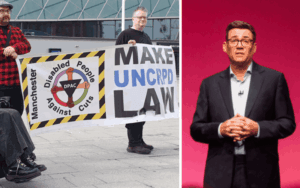
Dennis Queen, from Manchester Disabled People Against Cuts (MDPAC), who has taken part in numerous protests in Manchester (pictured, protesting outside a Tory party conference), said the admission from GMP was “extremely worrying to us, as it seems to mean that officers in GMP are making reports to the DWP, but without any kind of clear framework or guidance.
“On what basis are reports being made to the DWP? How does the police force know who has a relationship with the DWP? How do they decide when and how to contact DWP? Are individual officers taking it upon themselves to do it at random?”
She said: “This is unacceptable and we will do everything we can to work with Liberty to get to the bottom of this.
“Disabled people have the same right to protest as everyone else, and at least as many reasons to fight back.”
She pledged that MDPAC would continue to demonstrate against an “oppressive government” and those who profit from its policies.
Rick Burgess, also from MDPAC, added: “In the absence of official guidance, I advise the police to never pass on a disabled protester’s details to the DWP, because the ministry has been identified as a human rights abuser by the UN.”
Burgess suggested that Greater Manchester police might like instead to investigate DWP.
Sandra Daniels and Bob Williams-Findlay, who both took part in this month’s Extinction Rebellion protests in London as part of the Disabled Rebels group, said it was vital to ensure that the relationship between police forces and DWP was exposed to scrutiny.
They said that – for at least the last decade – disabled people had become caught up in a political agenda that suggested many of them were “faking their lack of functionality or simply abusing the system”.
They said this had been “supported by a rabid mass media presenting the scrounger narrative which increases disabled people’s anxiety and fear”.
But they also raised concerns that the lack of clarity and transparency over the actions of police was causing fear and anxiety among disabled people and was therefore playing into the hands of DWP because it helps it “continue its narrative of skivers and scroungers” and “monitor the growing militancy amongst disabled claimants”.
They said: “We need to ask how does taking part relate to claiming either employment and support allowance or personal independence payment.
“Both benefits operate activity descriptors, so unless the evidence shows a breach of these, the only possible use of the police’s information can be to trigger a fishing exercise or to intimidate.”
They added: “To what extent the police are gathering intelligence is hard to know for certain, or whether or not this is just a tactic to disarm and intimidate disabled people during this fractured moment in history.”
But they said: “The fear that now exists is a direct consequence of the policies and culture of the institutionally disablist DWP.
“We need to publicly hold the DWP and the police to account by demanding that their relationship is open to scrutiny.
“Whatever the truth is about this relationship and the type of information that is or could be passed on, what is clear from disabled people’s experiences at the Extinction Rebellion is that the police are showing increased contempt for disabled people’s rights.”
Sam Grant, policy and campaigns manager for the human rights organisation Liberty, said this week: “Some police forces have been found to be sharing information about disabled protestors with the DWP; this is likely to be unlawful.
“Forces need to guarantee that they will not report disabled people to the DWP simply for exercising their fundamental right to protest.
“Liberty is very concerned the police appear to have no guidance on how, why and when they would share information.
“Without guidance there will be inconsistency between police forces and protestors will have no idea under what circumstances and to what end their information is being passed on.
“The right to protest is one of the building blocks of our democracy and is a tool we use to protect all our rights.
“Any time the police undermine this right is a dangerous step, but it is particularly deplorable when they do so in a way that is discriminatory.”
The College of Policing – the professional body for those working in the police service in England and Wales – said in a statement on Tuesday: “Information sharing protocols are agreed between individual police forces and the relevant partner agencies and statutory bodies.
“In all cases officers and staff would be expected to use their professional judgement, comply with [data protection regulations] and information sharing protocols and follow the National Decision Model to guide their decision making around sharing information with other bodies based on the specific circumstances of each case.”
DNS told him that DWP had made it clear that there were no information sharing agreements with police forces, and asked him to explain what the “National Decision Model” was, but he had failed to comment further by noon today (Thursday).
The National Police Chiefs Council refused to provide an on-the-record comment on the freedom of information responses.
*Yesterday (Wednesday), Greater Manchester police confirmed in a freedom of information response to DNS that it had provided details of “a number of” disabled people to DWP following their involvement in protests.
It said this was done “on the basis of information sharing for the prevention and investigation of criminal offences, in order for DWP to undertake their own investigation” and is “believed to have included names, video and photographic footage”.
A note from the editor:
Please consider making a voluntary financial contribution to support the work of DNS and allow it to continue producing independent, carefully-researched news stories that focus on the lives and rights of disabled people and their user-led organisations.
Please do not contribute if you cannot afford to do so, and please note that DNS is not a charity. It is run and owned by disabled journalist John Pring and has been from its launch in April 2009.
Thank you for anything you can do to support the work of DNS…
 DWP forced to release report that includes ‘outrageous’ revelation about sub-standard assessment reports
 Burnham considers invitation to meet disabled activists when they celebrate UN anniversary in Manchester
 Alarm bells ringing after minister says all work is good for health, and he wants ‘everyone’ to get a job