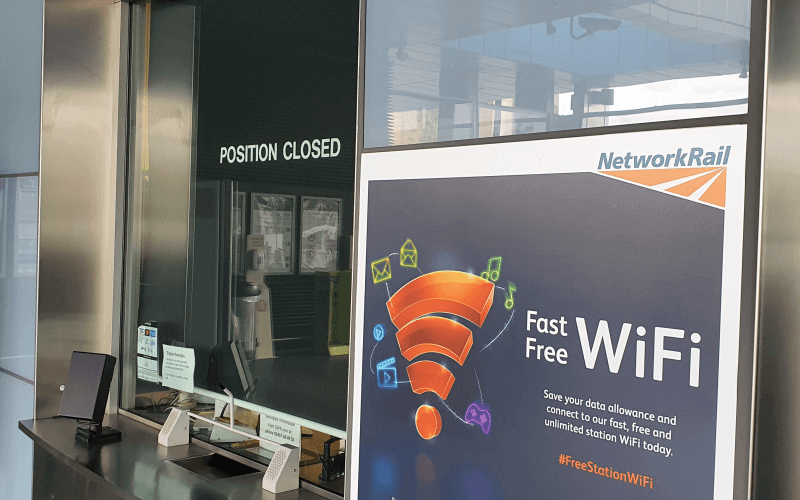
Disabled campaigners have raised fresh fears for the future of accessible rail travel, after reports that the government plans to close most train station ticket offices as part of a continuing programme of cuts.
A national newspaper reported on Sunday that the government’s reforms are likely to see about four-fifths of ticket offices closing.
The report came as new figures secured by Disability News Service (DNS) reveal a huge increase in the number of times that staffing problems are causing lifts to be closed and step-free access to be suspended across the London Underground network (see separate story).
The rail industry already faces concerns about an “escalating human rights crisis” for disabled passengers, caused by staffing issues across the rail network.
Last month, campaigners led by the Association of British Commuters (ABC) called on the Equality and Human Rights Commission (EHRC) to take “urgent action” on railway staffing.
EHRC warned three years ago that the move towards running more trains without a member of customer services staff on board – driver-only operated trains – and an increase in unstaffed stations, as well as the need for many disabled rail passengers to book assistance before their journeys, could be breaching the Equality Act.
In July, ABC secured a report by the Disabled Persons Transport Advisory Committee (DPTAC), the government’s accessible transport advisers, which concluded that staffing levels on a section of the rail network run by the UK’s largest rail operator – Govia Thameslink Railway (GTR) – were “completely inadequate to deliver an accessible railway”.
And earlier this month, a leaked document obtained by ABC showed GTR had admitted breaching access laws for more than 10 years across large parts of its network.
Now The Sunday Telegraph has reported that 25 of 30 East Midlands Railway ticket offices will be closed under a new contract, with this understood to be “broadly in line” with the government’s plans for the rest of the rail network.
ABC believes its research shows that closing ticket offices, combined with ongoing secret government discussions with the rail industry, will leave train companies free to reduce staffing at will.
Doug Paulley, a prominent disabled campaigner on accessible transport, also believes that closing ticket offices will mean cuts to station staff.
He said the Sunday Telegraph report confirmed the government’s plans to de-staff the railways, both in stations and on trains, which would make the railways “more hostile towards disabled people”.
He said: “This isn’t just about selling tickets. On many stations it means removing the only staff on the station.
“These staff make sure toilets are open and usable and heated waiting-rooms remain open.
“They answer queries and communicate with other staff to coordinate assistance or provide accessibility information. They are essential for security and safety.”
Paulley said he supported the RMT union’s “Staff Our Stations” campaign “100 per cent” and would return to the picket lines to support it.
He said the frequent combination of unstaffed stations and trains where the only member of staff is the driver make for a “particularly toxic combination”, which means there is “quite literally nobody present to assist disabled people to use trains”.
He said: “There’s no getting round it: actual staff, present bodily on trains and stations, are absolutely essential to disabled people’s ability to travel, reliably, safely and in comfort, as everybody else does and as is our right.”
Emily Yates, ABC’s co-founder, said she was “truly appalled” by the failure of regulators and advisory bodies to speak up on the de-staffing concerns and the potential impact on disabled passengers.
She said: “The Office of Rail and Road has been condoning unlawful staffing arrangements on GTR and at least four other franchises for more than a decade – with no adequate plan or deadline to correct this.
“DPTAC has been warning privately that rail de-staffing policies are ‘toxic’ and ‘illegal’ since 2016; however, it has failed to this day to make a single public statement.
“Even the EHRC has not responded to our urgent call for intervention, refusing since mid-August to give so much as a message of reassurance to disabled people, despite the obvious, widespread anxiety about railway de-staffing.”
She added: “This really is our last chance to stop an historic act of mass discrimination.
“Any organisation still staying silent about this matter will be fully complicit in the betrayal of disabled people’s right to independent living.”
Paula Peters, a member of the national steering group of Disabled People Against Cuts, said the closure of so many rail ticket offices would have a “horrendous impact on disabled people’s lives”.
She said: “Ticket offices are a vital lifeline for disabled people to travel; ticket office staff provide a variety of services, from supporting disabled people with journey planning to best deals on ticket prices and support with accessing the station.
“We feel safe knowing ticket office staff are there to assist and stations staffed.
“Many disabled people have access needs where smart phone technology and apps are not accessible to them.
“Ticket machines are very complicated to use with small screens and disabled people who are visually impaired or with a learning impairment cannot access them without support. Often ticket machines are vandalised.”
She also pointed to union reports of cuts to trained “safety critical” staff, and their replacement with agency staff without the same safety critical training, which she said would put disabled people’s safety at risk, both within the station and when boarding and leaving the train, and “could lead to serious injury or accidents”.
She said: “Critically safety trained staff provide vital support with wheelchair ramps, support with information and navigating the rail station.
“This will have a catastrophic impact on the right to ride and will marginalise and isolate disabled people even further from being able to live our lives.”
She said DPAC would accept nothing less than a rail network that was fully staffed with safety critical-trained staff, with ticket offices “kept open so that disabled people have the right to ride and be able to participate in society”.
An EHRC spokesperson said the watchdog was continuing its dialogue with campaigners and its consideration of evidence, and that the concerns were “still under consideration”.
The Department for Transport (DfT) said the proportion of train tickets bought in ticket offices had fallen from 34 per cent in 2012-13 to 12 per cent in 2021-22, with about two-thirds (68 per cent) of all National Rail tickets now bought online or through contactless payments.
DfT declined to say if ticket office closures would inevitably lead to some staffing cuts across the network; what action it would take to address the “escalating human rights crisis” on the railways; and whether it accepted that ticket office closures would lead to a significant negative impact on accessibility – and discrimination – for many disabled passengers.
But a DfT spokesperson said: “No final decision has been taken on ticket offices.
“Station staff are vital for passengers’ safety and passengers will always benefit from face-to-face assistance at train stations.
“The reality is ticket offices have seen a significant decline in use over the last decade, and by making station staff more adaptable we will have a better railway for passengers and taxpayers.”
A note from the editor:
Please consider making a voluntary financial contribution to support the work of DNS and allow it to continue producing independent, carefully-researched news stories that focus on the lives and rights of disabled people and their user-led organisations.
Please do not contribute if you cannot afford to do so, and please note that DNS is not a charity. It is run and owned by disabled journalist John Pring and has been from its launch in April 2009.
Thank you for anything you can do to support the work of DNS…
 National accessibility standards are crucial for addressing transport barriers, Tories hear at conference
 McFadden and Alexander keep their jobs, but Burnham replaces social care ministers
 Aviation bill will improve access to air travel but there is far more to do, say campaigning disabled peers