
The social security minister has still yet to decide whether secret reviews into deaths linked to the Department for Work and Pensions (DWP) can be released to grieving relatives, a year after he asked civil servants to examine the issue.
It is now a year since Disability News Service (DNS) asked Sir Stephen Timms why DWP refused even to alert families to the existence of internal process reviews (IPRs), let alone provide them with copies of the documents.
The minister said then that he had asked DWP officials “to have a look at this and to come back to me”.
But this week he admitted that he had still not reached a decision.
IPRs are carried out when there is a suggestion that DWP’s actions or failings may have negatively affected a claimant, and they have suffered serious harm, died, or attempted suicide.
DWP’s annual report and accounts showed the department agreed to investigate 166 cases of death or serious harm suffered by claimants through an IPR in 2025-26.
Of these cases, 110 followed the death of a claimant.
But the only routes for families to obtain an IPR after a relative has died are to take legal action or secure the assistance of a coroner.
It is believed that only two or three have ever been obtained from DWP.
This week, during an interview at Labour’s annual conference in Liverpool, Sir Stephen told DNS that there were some “quite complicated legal issues in the Social Security Administration Act” which DWP was looking at before it could decide whether IPRs could be released to families.
He accepted that the key issue was that the act states that the work and pensions secretary must approve the release of such documents.
But he said the key issue is that “in a lot of these documents there is very, very sensitive information, the release of which could harm some people who are identified”.
He accepted that most of these people are already dead but that the reviews could also include sensitive information about other people, including living relatives.
DNS then pointed out – just as in an interview with Sir Stephen at last year’s Labour conference – that safeguarding adults reviews and domestic homicide reviews, which often examine the same deaths as IPRs, are released to relatives and are published with names and identifying details removed.
Sir Stephen said: “I haven’t looked at domestic homicide reviews; they are not my brief.
“I’d forgotten you’d made that point last year, I’ll take that away. There may be a precedent there that we could use.”
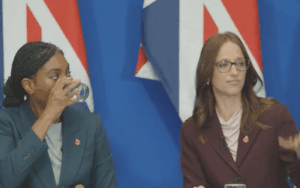
Among those trying to secure an IPR is Joy Dove (pictured, centre), whose daughter Jodey Whiting took her own life in February 2017.
DNS reported last year that a second inquest into her death – which only happened because of her mother’s eight-year campaign for justice and accountability – found that her “deteriorating” mental health had been “precipitated” by the withdrawal of her out-of-work disability benefits after she missed a work capability assessment.
But DNS also showed how DWP hid the truth from the coroner about its role in her suicide, including by failing to confirm if an IPR was carried out.
Sir Stephen also insisted that the department was making “good progress” on safeguarding, and that – as planned – he and colleagues would review at the end of the year whether DWP needed to introduce a statutory safeguarding duty.
And he praised the work of Dr Gail Allsopp, who has played a central role in safeguarding improvements within the department but has stepped down from her post as chief medical adviser after it became clear that DWP was not planning to reappoint her on a further three-year contract.
DNS pointed to figures it secured through a freedom of information request which revealed that 50 IPRs into claimant deaths had led to internal calls for improvements within DWP in 2025-26, and asked Sir Stephen what those figures suggested to him about the scale of harm within his department.
Sir Stephen pointed to the department’s safeguarding strategy, and he said not all the deaths investigated through IPRs were caused by the department’s actions.
He said: “It is not the case that a failure in the department has caused each of those deaths, although in some tragic cases that may be the case.”
But he added: “I agree with you that 50 is a significant number.
“I think what that underlines is the department is doing the work that is needed to learn when problems are brought to our attention and that’s what the department needs to do.”
Following concerns raised last month by Labour MP Rushanara Ali, and scores of deaths of claimants linked to universal credit – and investigated through the IPR process every year – including the suicide of David Panther in January, DNS also asked Sir Stephen whether he believed the universal credit system was safe.
He said: “I don’t think there’s anything inherently unsafe about universal credit.
“We’ve got to make sure that it is a safe system in which the interests of people claiming benefit are safeguarded.”
But figures secured from DWP by DNS show there were 113 cases accepted by the department for an IPR in 2025-26 in which the claimant was receiving universal credit.
And in July, DWP published anonymised details from IPRs from 2023-24, which revealed multiple serious failures within the universal credit system that were linked to deaths and serious harm suffered by claimants.
*The following organisations are among those that could be able to offer support if you have been affected by the issues raised in this article: Mind, Rethink, Samaritans, and SOS Silence of Suicide
 DWP forced to release report that includes ‘outrageous’ revelation about sub-standard assessment reports
 Tories announce seven ways they will attack disability benefits if they win the next election
 Badenoch ignores analysis that shows her ‘catastrophic’ £1 billion plans would decimate the Motability scheme