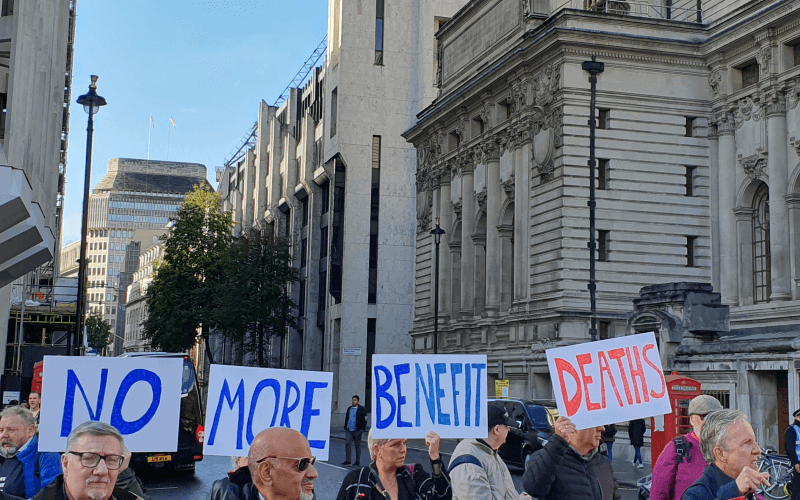
The Department for Work and Pensions (DWP) admitted in a secret paper that the cumulative effect of multiple errors or “inaction” on benefit claims caused situations to “spiral out of control for vulnerable customers” and even led to their deaths.
DWP admitted there was a risk it had become “unintentionally desensitized” to such failures, or “process non-compliance” as it is described in the paper.
And because so little information was gathered in one crucial section of its work, it confesses in the paper that it was “impossible to establish how poor our service might be” in that area.
The paper, Errors that can cause serious cases, provides some of the strongest evidence yet from the past decade that the department is not fit for purpose, and that its processes and failings continue to put the lives of disabled claimants at risk.
The paper was only released to Disability News Service (DNS) after a three-year legal battle.
The information rights tribunal ordered the department to release the document in March, after DWP appealed against a decision by the Information Commissioner’s Office that it should release the report.
The department continued to argue that some of the information in the paper could have “a negative reputational impact” if it was released to DNS, and that it was “already subject to a significant amount of scrutiny”, and that it “ought to be able to engage in important internal discussion and to effectively make decisions, in particular when discussions about sensitive decisions are still live”.
DWP initially considered appealing against the tribunal’s decision, before deciding last week to finally release the paper to DNS.
The tribunal panel, led by Judge Sophie Buckley, had concluded that there was “an extremely strong public interest in the public being able to contribute to an informed debate and hold the DWP to account in its treatment of vulnerable claimants, and in scrutiny of the action being proposed or taken in that area”.
The paper was discussed in October 2022 (PDF) by DWP’s serious case panel, which was set up in 2019 to examine how departmental failings have led to serious harm, or even the deaths, of claimants.
The paper includes a heavily-redacted example of how a series of DWP failings led to a claimant’s death over the course of a year – following the case through from its original “delayed action”, to “no call back”, to “customer wrote to complain” and then to “no call back to customer” – resulting in the final entry: “Family friend calls to report customer’s death…”
The paper focuses on two types of DWP shortcomings: failing to call back claimants as promised, and failing to update an address or making mistakes with addresses when a claimant moves home.
It concludes that there is “minimal consistency in how call backs are managed across the Department”, while there “exists a culture within the Department in which it is comfortable operating from a point of ignorance on call back volumes and adherence to promises made”.
It says that different departments within DWP – known as “directorates” – have “become comfortable in not knowing the truth”.
And because “little to no” detailed information is gathered, “it is impossible to establish how poor our service might be”.
DWP’s Call Listening Alert Service, which listens back to a sample of phone calls received by the department, found 87 “high-risk calls” concerning disclosures of suicidal ideation and self-harm that were “directly related to failure to action a request for a call back”.
The paper also found that failing to call back claimants had been identified in 15 internal process reviews (IPRs)*, while an internal investigation found that “as a department we don’t have a firm grip on honouring promised call backs”.
It also found that failing to action a change of address had been identified in nine IPRs.
Most IPRs are carried out following the death of a claimant.
A sample of employment and support allowance (ESA) cases where there had been a change of address found errors in one in nine cases (11.38 per cent), while there were similar errors in more than one in 14 state pension cases (7.37 per cent).
The paper adds: “From serious cases we see the worst impacts of a customer ‘moving house’ and not receiving post include being deprived of disability premiums and failing to attend vital appointments leading to claim closures and sanctions.”
The paper also reports that only 12 per cent of “escalated” ESA call backs were carried out in time “although the data could be flawed in which case we can’t say how we performed”.
And it warns that universal credit allows “4 consecutive failed call backs” to take place because the system has four escalation levels which are triggered by repeated contact from a claimant.
The paper includes recommendations for major improvements to call backs and changes of address, including “considering how we drive a cultural (sic) of adhering to customer promises and supporting our most vulnerable customers”.
It also suggests an improvement strategy among DWP staff to raise the “profile and social consequences of errors relating to change of address” and a new training product that would use serious cases to “highlight the potential impact of call back, change of address, and other ‘minor’ errors on vulnerable customers”.
It is not yet clear whether these recommendations were implemented.
The paper is the latest evidence – now stretching back more than a decade – that shows how DWP’s actions and failings have harmed disabled claimants, and led to hundreds, if not thousands, of deaths.
Sir Stephen Timms, minister for social security and disability, had not responded to a request for a comment by noon today (Thursday).
*IPRs are carried out when there is a suggestion that DWP’s actions or failings may have negatively contributed to a claimant’s circumstances, and the claimant has suffered serious harm, has died, or there has been an attempted suicide
**The Department: How a Violent Government Bureaucracy Killed Hundreds and Hid the Evidence, DNS editor John Pring’s book on the years of deaths linked to DWP’s actions and failings, is published by Pluto Press
 Union report exposes how staffing crisis at DWP is harming ‘vulnerable’ claimants
 Thousands of disabled people could benefit from activist’s universal credit and council tax court win
 DWP forced to release report that includes ‘outrageous’ revelation about sub-standard assessment reports