Disabled Labour activists say they have seen some early signs of improvement in the way the party works with them on disability equality, in the two months since Andy Burnham became prime minister.
Disability News Service reported last year how senior figures in the Labour party had pledged to try to rebuild trust with disabled people.
Disabled activists linked to the party had been particularly concerned at the damage caused by the government’s attempts – later abandoned – to cut billions in spending from personal independence payment (PIP), and the cuts that were introduced this year through its Universal Credit Act.
They also wanted to ensure disabled people “have a voice and can be heard in a constructive way” by the party.
A year on, and now under the new leadership of Andy Burnham, some of the activists involved in those negotiations said they believed there were signs that the change in leadership may have started to make a difference.
Speaking at Labour’s annual conference in Liverpool this week, key figures in Disability Labour – a socialist society affiliated to the party – said there had been some initial positive signs in the first couple of months since Burnham took over from Sir Keir Starmer as prime minister.
In one symbolic step, Disability Labour – among other socialist societies affiliated to Labour – was invited to be represented in Downing Street when Burnham entered No 10 for the first time as prime minister.
Joe Watkinson, vice chair of Disability Labour, said: “I was on the street when he came up.
“It’s a great thing for the socialist societies as a whole and great to be there and represent disabled people in that public place on a massive day, on a historic changing of the guard.”
He said there was now “more of an optimism” among disabled activists around working with the party, and he said he believed there had been a change of approach under Burnham, who is a patron of Disability Labour.
Sir Stephen Timms, the minister for social security and disability, also said this week that he believed there had been a shift in attitudes towards disability policy since Burnham became prime minister.
He said: “When he reappointed me [as minister], Andy said to me that he felt that the work he had done with disabled people in Greater Manchester was a very important part of the work he has done as mayor.
“This whole policy area is kind of high up in his thinking and I think that is going to colour the work of the government in this area over the next few years.
“He made it clear that it is important for him, it has been important for him, and it will be in the future.
“I think the fact that the prime minister is someone who is clearly personally interested in this policy area is a positive development in the government’s approach.”
Disabled activist Rick Burgess, who was at the conference this week on behalf of Amnesty International’s Disabled People’s Human Rights Network, said: “Andy Burnham needs to talk to us and not people talking for us.
“The people chosen by Keir Starmer to conduct reviews are not the experts he should be listening to; our expertise has the solutions.”
He said disabled people were “more than ready” for the “new politics” Burnham spoke of in his speech to the conference on Tuesday, and he pointed to a string of disabled-led reviews, organisations and networks.
These include the National Independent Living Service (NILS), the Roadmap to Independent Living, the Commission on Social Security, The Alliance for Inclusive Education, DPO Forum England, and the Disabled People’s Human Rights Network.
But he said the voices of non-disabled people were still “blocking the changes that will actually work in removing disabling barriers from society”.
Senior figures in Disability Labour spoke to Burnham earlier this year about the problems caused by only allowing disabled people to use concessionary bus passes after 9.30am, which particularly creates issues for those who need to travel for work, health or education reasons.
One of Burnham’s early announcements, in August, was to announce that these restrictions would be lifted across England from next April.
Watkinson said the “jury is out” on whether the approach on disability had changed but he was “hopeful” about the new prime minister.
Among Disability Labour’s continuing concerns are around the ongoing review of PIP, and the failure of the minister in charge, Sir Stephen, to seek the views of Disability Labour.
Watkinson said: “It certainly doesn’t seem to be the co-production we would hope for.”
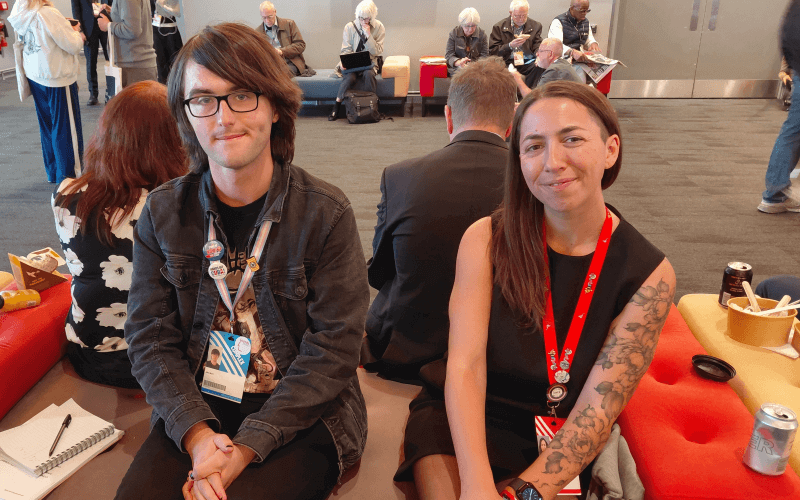
Emily Pomroy-Smith, who this week began her term as the new representative of disabled party members on Labour’s national executive committee (NEC), said there had been “positive signs as soon as Andy took office”.
She said: “When it comes to the multiple reviews coming out, we will reserve our views until they actually are published.”
She was elected to the position unopposed this summer but had been standing on a platform of four key asks of the party.
The first, to allow constituency Labour parties (CLPs) to hold hybrid meetings which allow disabled members to vote remotely, was overwhelmingly approved at this week’s conference.
She also plans to set up a network of the disability officers within the party and the wider trades union movement.
And she is hoping to persuade the party to approve training on the social model of disability for key local Labour figures, starting with group leaders and whips on local councils, and then more widely so it is “embedded in party culture” and MPs and future leaders “have that embedded in their culture and understanding to ensure the party has that at its heart”.
Pomroy-Smith’s final key ask of the party is for a training programme for disabled members who may be future leaders or election candidates “because we really need to increase representation, and the way we do that is to break down those barriers and identify talent”.
She said this could help to change the culture within the party so that MPs feel safe to identify publicly as disabled people.
And she said she wanted to build on the “legacy and hard work” of her predecessor Ellen Morrison-Smith – and thanked her on behalf of disabled party members for her work – who was the first disabled members’ representative on the NEC and served in the position for nearly six years.
Alex Burt, secretary of Disability Labour, told a fringe meeting of the Campaign for Labour Party Democracy on Saturday that the rule change on hybrid meetings was “a massive thing for accessibility” and “huge for democracy and engagement”.
Speaking before the change was approved by the conference, they said: “As a previous CLP secretary, I have seen the existing guidance weaponised to lock disabled left-wing members out of the party structures, and this change, though insignificant it may seem, rips another arrow out of the quiver of the centralising technocrats that have driven this party to the brink of ruin.
“One rule change does not make a full culture change, and what we as a socialist society and comrades in the wider disability liberation movement – indeed our comrades in the wider Labour movement – need is for a Labour party that is willing to listen and engage with us again.
“Perhaps, given his status as one of our patrons, and given what he has said so often this year as he jostled for the leadership, Burnham can be better.
“His announcement on the disabled people’s bus pass – now it works before 9.30am – was a promise he made to us as a socialist society back in February.
“But change has got to be more fundamental than that.”
Picture: Alex Burt (left) and Emily Pomroy-Smith
 Burnham will evade questions from chair of work and pensions committee on Milburn and Timms reports
 Burnham considers invitation to meet disabled activists when they celebrate UN anniversary in Manchester
 The Times blocks DNS from raising concerns with its readers about DWP deaths, in response to Burnham ‘welfare inquiry’ article