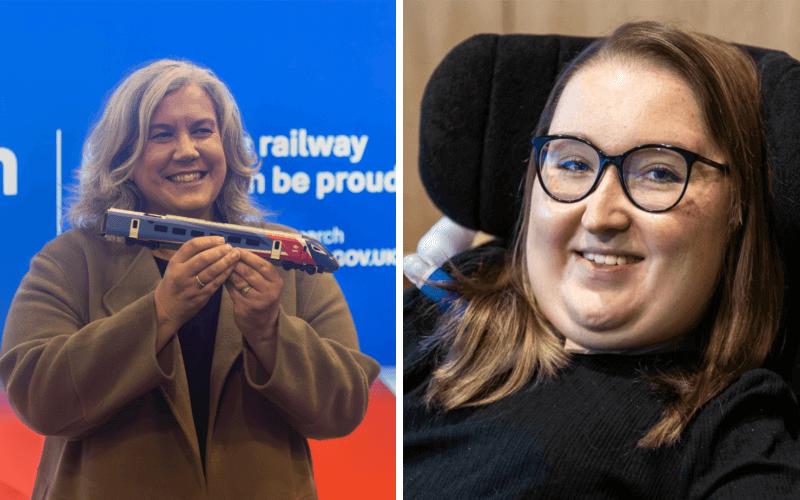
A statutory duty in the new railways bill to ensure ministers and public bodies promote the needs of disabled passengers is “too vague” and must be strengthened as the legislation passes through parliament, MPs were told yesterday (Wednesday).
The transport select committee was hearing evidence from experts a day after the government’s railways bill passed its second reading in the House of Commons.
Emma Vogelmann, co-chief executive of the disabled people’s organisation Transport for All (TfA), welcomed the inclusion in the bill of a statutory duty that will force those in charge of the railways to take account of “the needs of disabled persons”.
Labour had previously dropped plans to ensure there was a statutory duty on accessibility in the bill.
But Vogelmann told MPs on the committee that the duty’s wording was “very vague” and “too unenforceable” and “doesn’t guarantee improvements for disabled passengers”, despite the “desperate change that is needed in terms of accessibility”.
She said TfA wanted the bill strengthened so there was a duty to “actively and continuously improve accessibility across the rail network” and ensure there are “measurable outcomes” that show what progress is being made every year.
The bill currently says that ministers, Great British Railways (GBR) and the Office of Rail and Road will have a duty to carry out their roles – alongside other statutory duties – in “the manner best calculated to promote the interests of users and potential users of railway passenger services including, in particular, the needs of disabled persons”.
But Vogelmann told the MPs the legislation should be strengthened to “make sure that accessibility is enforceable and that it is an over-riding, consistent priority for Great British Railways as opposed to at the moment where we feel it is potentially not given enough enforcement power and it is subject to political will in some instances”.
She said the current wording of the duty was “almost purposefully vague”, which risked perpetuating the “tick box” culture and lack of meaningful action on accessibility across the rail system.
She added: “The lack of enforceable standards, the lack of enforceable actions, is really why disabled people feel excluded from the rail network at the moment and why many of us face so many barriers.”
The previous day, a string of MPs had highlighted the need for meaningful improvements to accessibility on the railways, during the bill’s second reading.
The bill will create GBR, a new publicly-owned company that will bring together management of passenger services and rail infrastructure.
The government also plans to use the bill to introduce a stronger passenger watchdog and to simplify fares and tickets.
Transport secretary Heidi Alexander told MPs the bill would “sweep away the fragmentation and dysfunction that have plagued the railway for too long and will bring the 17 organisations involved in running the railway together into one public body, Great British Railways, which is the directing mind that this industry has long called for”.
Many MPs in the debate called for improvements to the government’s Access for All programme, which funds access improvements at rail stations.
Conservative MP Mark Pritchard said “more needs to be done on step-free access” because there was “currently very little in the bill that suggests that more will be done, particularly for rural stations such as Cosford, Shifnal or Albrighton in Shropshire.
“If it cannot be done at every station, and there is no money for that, there at least needs to be step-free access and improved disability access somewhere along inter-county railway lines.”
Adam Dance, the Liberal Democrat MP for Yeovil, said: “Too many rural railway stations are not accessible for disabled people.
“Without support staff, constituents in Yeovil have had serious accidents at railway stations.
“Although the government’s accessibility priorities, which we are debating today, are welcome, does my honourable friend agree that we need a strengthened Access for All programme?”
Keir Mather, a junior transport minister, told MPs he had “heard the calls from colleagues across the house about the importance of the Access for All scheme”, and that the government was continuing to fund the scheme.
Disability News Service reported last month that the government’s new “roadmap to an accessible railway” – covering England, Scotland and Wales – appeared to suggest a reduction in real spending on the Access for All programme, with the roadmap promising a future commitment to only spend “up to” £70 million a year.
Conservative and Liberal Democrat MPs voted against the bill receiving a second reading, but it was easily passed by 329 votes in favour to 173 votes against.
Picture: Heidi Alexander holding a miniature train in the new Great British Railways livery, and Emma Vogelmann
A note from the editor:
Please consider making a voluntary financial contribution to support the work of DNS and allow it to continue producing independent, carefully-researched news stories that focus on the lives and rights of disabled people and their user-led organisations.
Please do not contribute if you cannot afford to do so, and please note that DNS is not a charity. It is run and owned by disabled journalist John Pring and has been from its launch in April 2009.
Thank you for anything you can do to support the work of DNS…
 Slow but steady progress on UK air travel access improvements, says report
 Level boarding pledge in government strategy is welcomed, but railways bill amendments are still vital
 National accessibility standards are crucial for addressing transport barriers, Tories hear at conference