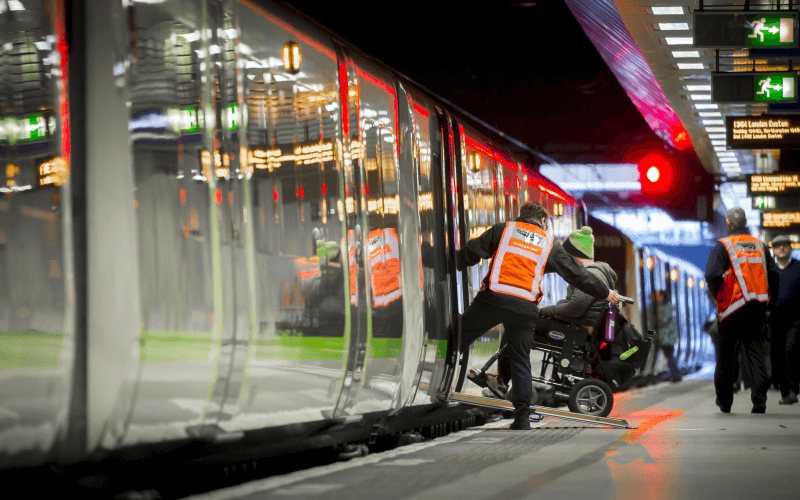
Disabled campaigners have dismissed a watchdog’s “misleading” new league table that claims to show the best performers in assisting disabled rail passengers.
The “benchmarking” report by the Office of Rail and Road (ORR) claims that two of the best-performing train companies for passenger assistance are Govia Thameslink Railway (GTR) and Southeastern.
But GTR and Southeastern are the train companies that have gone furthest in running driver-only operated trains to unstaffed stations, often replacing onboard and station staff with roving “mobile” staffing units, say campaigners.
Three years ago, GTR admitted in a leaked document that it had been breaching access laws for more than 10 years across large parts of its rail network.
Southeastern and GTR were also highlighted three years ago by The Association of British Commuters (ABC) as key offenders for denying disabled passengers the ability to “turn up and go” (TUAG) without booking assistance in advance.
ORR claims Southeastern has the best score for reliability (based on the proportion of disabled passengers who received none of the assistance they had booked in advance) over the last three years.
It ranks the top five providers as Southeastern (eight per cent said they received none of the assistance they had booked), LNER (eight per cent), Network Rail (eight per cent), Avanti West Coast (nine per cent) and GTR (10 per cent).
The worst performer is Northern Trains, with 16 per cent, with South Western Railway (15 per cent) and West Midlands Trains (14 per cent) only slightly better.
Five of the top nine performers in the ORR league table – Southeastern, GTR, Great Western Railway, Chiltern Railways and Greater Anglia – were found by ABC research in 2022 to be discriminating against disabled passengers by regularly denying TUAG services to those who need boarding assistance.
Emily Sullivan, a disabled researcher in equality and human rights and co-founder of ABC, said she was “sceptical” about whether the ORR figures provided an accurate picture of equality and discrimination when it came to passenger assistance.
She said Southeastern and GTR were “the same two operators where driver-only operation and ‘mobile staffing’ are most progressed, after years of cuts to onboard and station staff”.
And she said that ranking train operators by their performance on pre-booked assistance was “a gift for potential train operator manipulation of the system, which could even make the worst for TUAG appear to be the ‘best’ for booked assistance.
“The use of a league table is also misleading due to the very different types of networks and patchwork of different staffing policies.
“The standards for data collection are themselves discriminatory and every time they publish data including only ‘booked assistance’ they are by implication telling disabled people they do not have the equal right to travel.”
Another leading disabled campaigner, Christiane Link, a consultant and adviser on accessibility, also criticised the ORR figures.
She said: “I don’t think these statistics are sound. They focus too much on booked assists and ask people after months about their travel experience.
“I think it’s overdue that the ORR focus more on the provision of Turn Up and Go, not just booked assists, and ask people directly after travelling about their experience, not months later.”
It is the first time ORR has attempted to rank rail passenger assistance.
The regulator particularly shamed South Western Railway (SWR), West Midlands Trains (WMT) and Northern Trains for their poor performance.
It said SWR and WMT “showed a pattern of sustained poor performance in delivering reliable passenger assistance” and have been asked to submit “detailed action plans” for improvement.
Despite already having been told to implement an improvement plan following concerns raised last year, Northern told ORR four months ago that about 800 passenger-facing staff had not completed disability awareness training.
ORR has now launched a formal investigation into this failing by Northern.
The regulator plans to expand its benchmarking framework next year to include new data sources and measures such as post-assistance passenger confidence, staff training compliance, TUAG reliability, and feedback on the Passenger Assist mobile phone app.
Picture by ORR
 Level boarding pledge in government strategy is welcomed, but railways bill amendments are still vital
 Nationalised rail firm ‘was desperate’ to settle trio of discrimination cases, as calls mount for stronger laws
 Ministers condemned for ‘outrageous’ failure to listen to ‘vital’ demands on accessibility in railways bill